Ethical DilemmasThought experiment and dilemma variants
Trolley Problem: Foot's Original Has a Driver, No Bystander
Source card
Texts this entry reads, by coordinate and edition.
- Kamm 2013, Lecture 1, pp. 133–148, 157–158; Lecture 2, pp. 167–169, 185Tanner Lectures on Human Values, University of California, Berkeley, March 19–21, 2013Source [5] · open the text
- Foot's tram driver, judge and gas casesas reported in Kamm 2013, Lecture 1, pp. 133 and 136, and SEP "Doing vs. Allowing Harm", sec. 3Source [1] · open the text
- The Monist 59(2), p. 206: Edward, David and the name; the pushing case, no page givenas quoted and cited in Kamm 2013, Lecture 1, nn. 2 and 7Source [2] · open the text
- Yale Law Journal 94(6), pp. 1397 and 1401: Bystander at the Switch; the Loop Case, no page givenas cited and quoted in Kamm 2013, Lecture 1, nn. 8 and 12, and Lecture 2, n. 13Source [3] · open the text
- Philosophy & Public Affairs 36(4), pp. 364, 368 and 369as cited in Kamm 2013, Lecture 1, nn. 5, 13 and 15, and summarized in SEP "Doing vs. Allowing Harm", sec. 3Source [4] · open the text
Show 4 more, VI–IXHide VI–IX
- SEP "Doing vs. Allowing Harm", sec. 3substantive revision 2025-07-08Source [6] · open the text
- SEP "Doctrine of Double Effect", opening summary and secs. 2 and 4.5substantive revision 2023-07-17Source [7] · open the text
- Schuster 2023, section "Switchman Case (Weichenstellerfall) and the Trolley Problem", nn. 28–33 and 43Criminal Law Forum 34(2), 2023, CC BY 4.0Source [8] · open the text · Text licence: CC BY 4.0
- Kohler 1915; Engisch 1930; Welzel 1951as cited in Schuster 2023, nn. 28, 29 and 30Source [8] · open the text · Text licence: CC BY 4.0
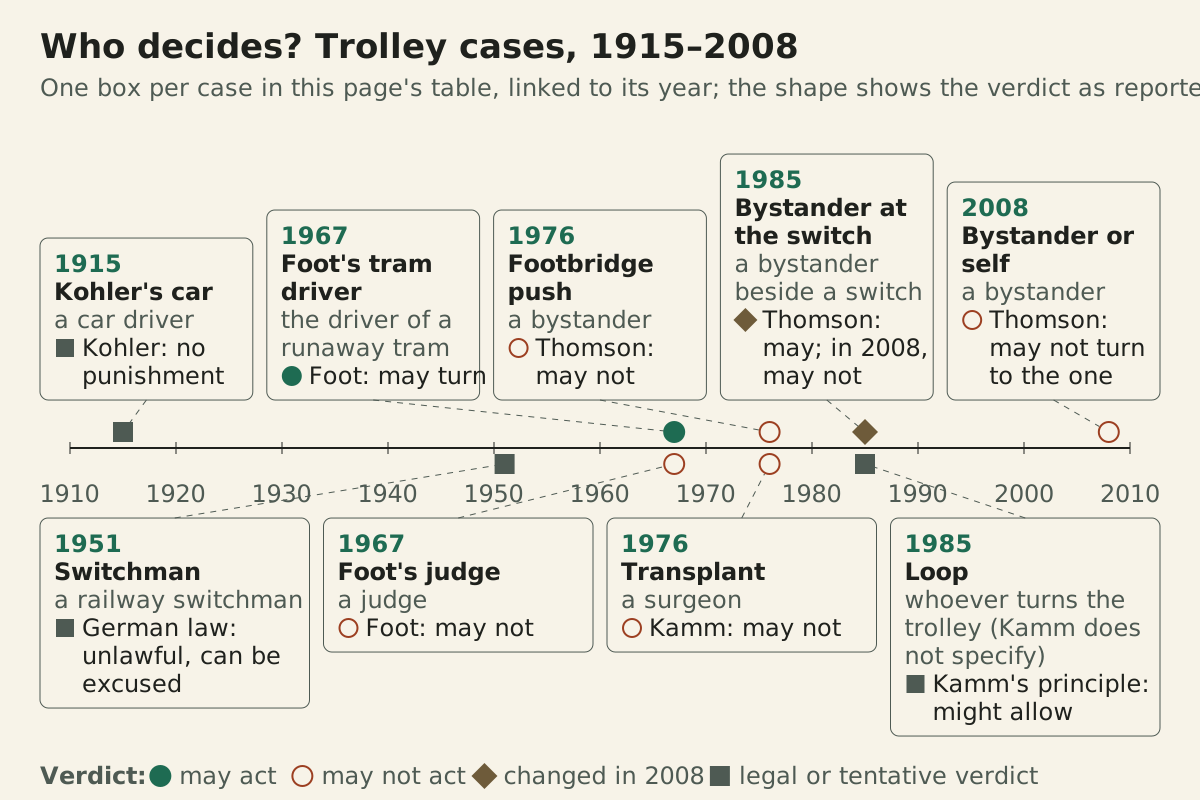
In Philippa Foot's 1967 version of the trolley problem, the person who decides is the driver. The trolley problem asks why turning a runaway trolley from five people toward one seems permissible when other ways of killing one to save five do not. Foot's tram cannot brake, and its driver can only send it from the track with five people onto a track with one, as F. M. Kamm's 2013 Tanner Lectures report her case (Lecture 1, p. 133). The bystander at a switch came later, from Judith Jarvis Thomson, who named the problem in 1976; in 2008 she reversed her own verdict and argued that the bystander may not turn the trolley.
Here the two philosophers' papers are reported only through four readable sources: Kamm's lectures, two entries in the Stanford Encyclopedia of Philosophy (SEP), and a 2023 article on German criminal law by Frank Peter Schuster. Where those sources disagree, both readings are given. How Claims Are Tested explains how this site handles sources in conflict.
What was the original trolley problem?
The trolley problem goes back to a pair of examples in Foot's 1967 paper, "The Problem of Abortion and the Doctrine of the Double Effect" (Kamm, n. 1; the SEP entry "Doing vs. Allowing Harm" cites a 1978 reprint). The doctrine of double effect holds that causing a harm as a foreseen side effect can be permissible even where causing the same harm as a means would not be (SEP, "Doctrine of Double Effect"). Foot sets her tram beside a judge.
 Generated illustration
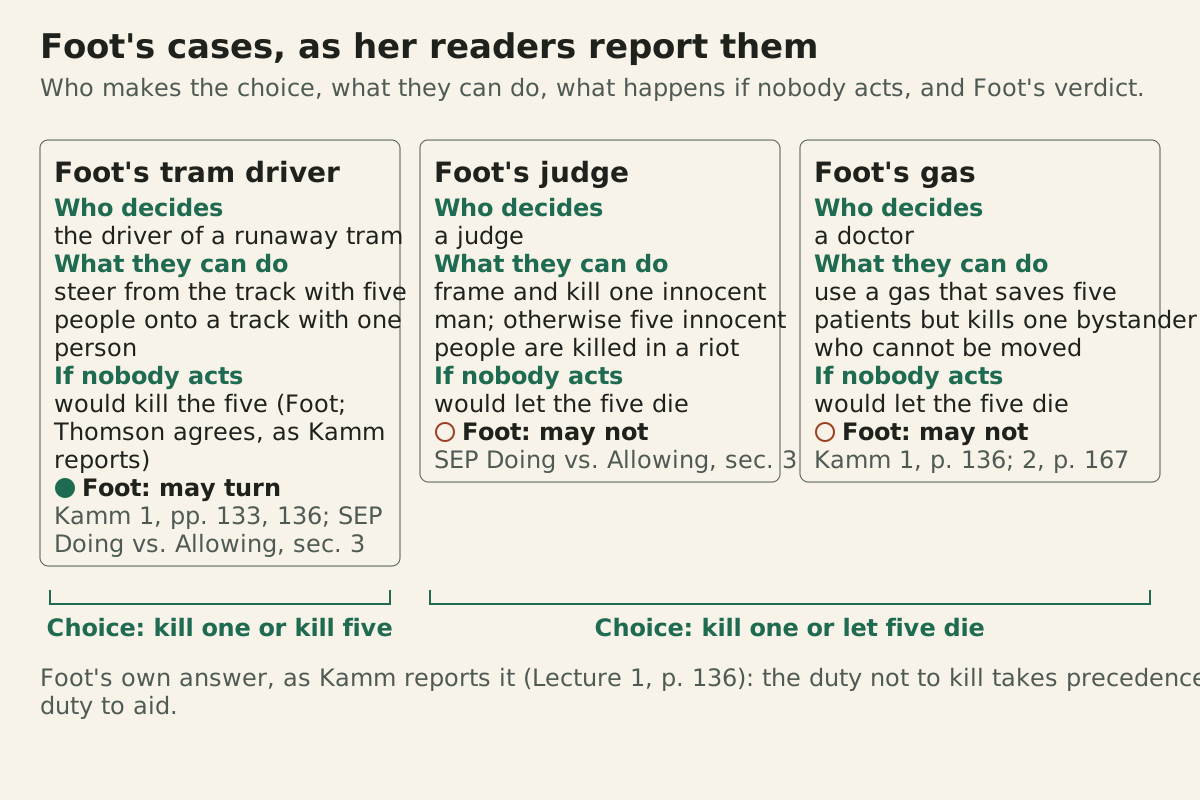
As the SEP entry "Doing vs. Allowing Harm" summarizes the pair, the judge can stop a riot that will kill five people only by framing and killing one innocent man. The driver must choose between turning his trolley onto one man and letting it run over five. Foot held that killing was wrong in the judge's case but not in the driver's.
Foot noted that the pair might lead someone to accept double effect, but she did not rest on it. Kamm reports her counterexample: it seems wrong for a doctor to use a gas that saves five patients but kills one bystander who cannot be moved, though that death is only a side effect (Lecture 1, p. 136). Her own answer was about duties: the driver chooses between killing five and killing one, while the judge chooses between killing one and letting five die. In her view, the duty not to kill takes precedence over the duty to aid (SEP, sec. 3; Kamm, p. 136).
Did Foot's tram have a lever?
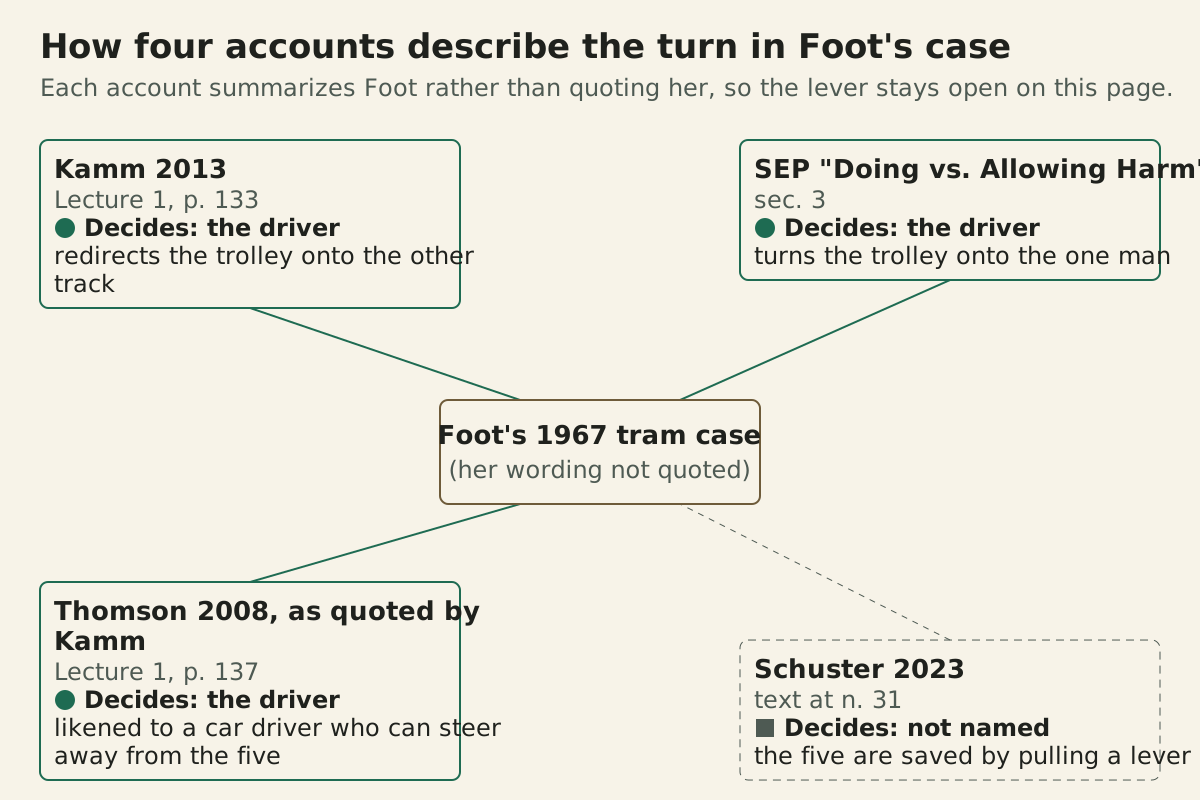
The accounts differ on how the tram is turned. Kamm says the driver redirects the trolley, "which Foot called a tram" (Lecture 1, p. 133); the SEP entry says the driver turns it. Kamm also quotes Thomson's 2008 comparison of Foot's driver to a car driver whose brakes fail and who can steer away from the five (p. 137).
Schuster's legal summary says the five can be saved "by pulling a lever" (text at n. 31) and names no one who pulls it. All four accounts summarize Foot rather than quote her, so this page leaves the lever open. Kamm, the SEP entry and Thomson's comparison all put the choice with the driver.
Who named it the trolley problem?
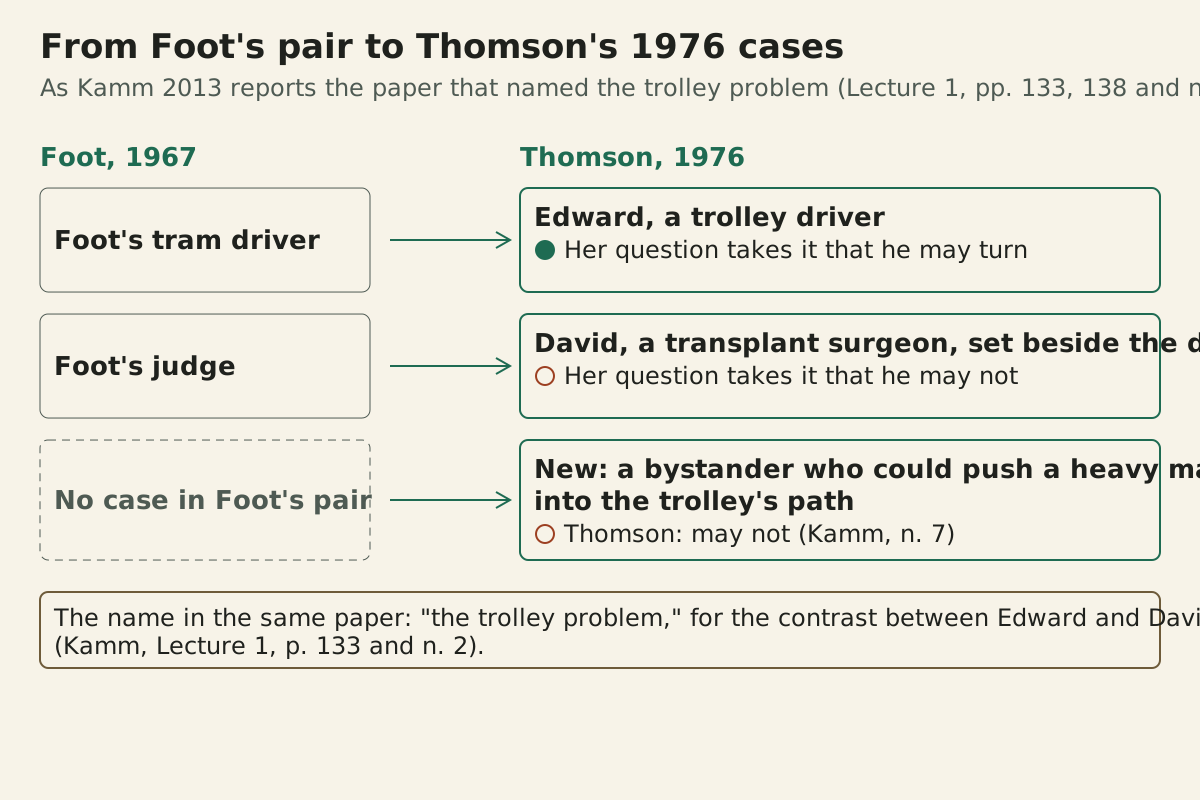
Judith Jarvis Thomson gave the problem its name in "Killing, Letting Die, and the Trolley Problem," published in The Monist in 1976. Kamm's notes quote the passage. Thomson calls Foot's driver Edward and sets him beside David, a transplant surgeon who could save five patients with the organs of one healthy person:
"Why is it that Edward may turn that trolley to save his five, but David may not cut up his healthy specimen to save his five? I like to call this the trolley problem, in honor of Mrs. Foot's example."
Thomson 1976, The Monist 59(2), p. 206, as quoted in Kamm 2013, Lecture 1, n. 2
So the name first marked a contrast between a driver and a surgeon, not a choice at a switch (Kamm, p. 133). By Kamm's account, the same paper adds a bystander who could stop the trolley only by pushing a heavy man into its path, and Thomson judged that push impermissible (p. 138 and n. 7). The SEP entry "Doctrine of Double Effect" and Schuster cite her 1985 paper for the pushing case.
When did the bystander at the switch appear?
Kamm and the SEP entry "Doctrine of Double Effect" trace the bystander who can throw a switch to Thomson's 1985 Yale Law Journal paper, "The Trolley Problem." Kamm dates the Bystander at the Switch case to page 1397 of that paper: the driver can do nothing, and a passer-by can press a switch that turns the trolley onto one person (Lecture 1, p. 139 and n. 8).
The SEP entry "Doing vs. Allowing Harm" gives another date. It credits "Thomson (1986)," a book chapter with the same title as her 1976 paper, with making the chooser a bystander, and it counts 22 years from that version to her 2008 reversal. The two dates are set side by side here, since the sources do not agree.
The change mattered to Foot's answer. A passer-by who does nothing only lets the five die, so if he may still turn the trolley, the line between killing and letting die cannot explain both cases (SEP, sec. 3; Kamm, p. 139). Thomson moved the name with the case. Kamm quotes her 1985 paper asking why the bystander may turn his trolley though the surgeon may not operate, calling that question "The Trolley Problem," and inviting anyone more puzzled by the surgeon to call it "The Transplant Problem" instead (n. 12, quoting p. 1401).
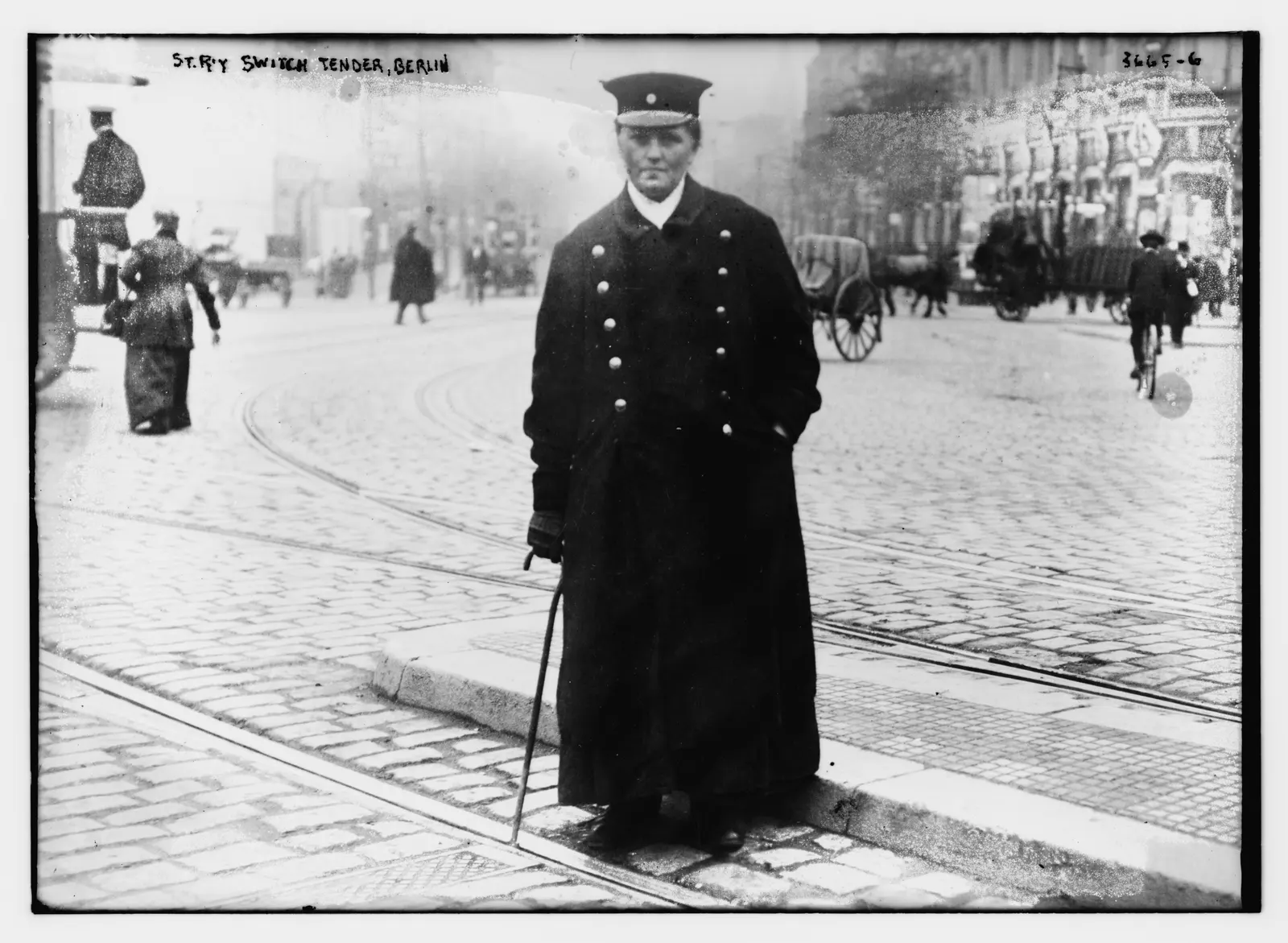
The same paper introduced the Loop Case, in which the side track bends back toward the five and only the one person's body stops the trolley (Kamm, Lecture 2, pp. 168–169 and n. 13). Switch tenders were a real job. The photograph below shows one on a Berlin street railway.
_Switch_Tender,_Berlin_LCCN2014700260.jpg)
Did Thomson change her mind about the bystander?
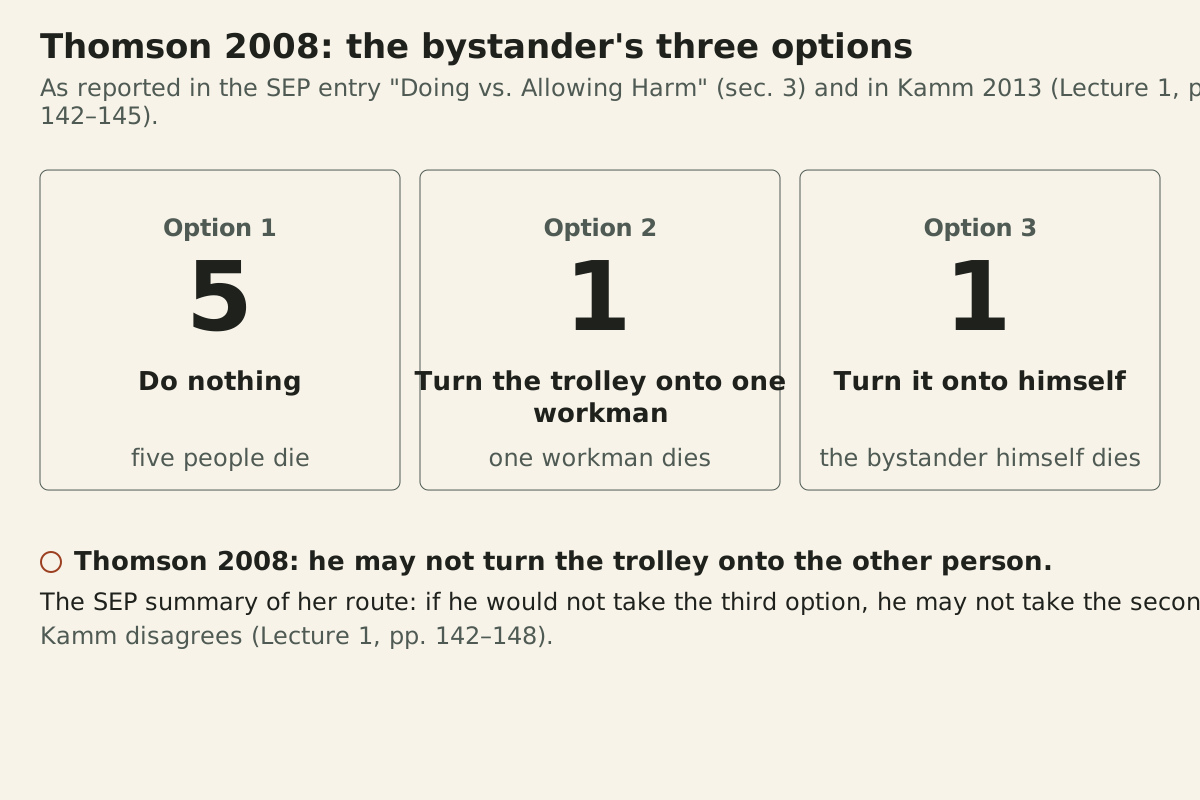
Yes. In "Turning the Trolley" (2008), Thomson argued that the bystander may not turn the trolley after all.
The SEP entry "Doing vs. Allowing Harm" summarizes her route. She gives the bystander a third option, turning the trolley onto himself. If you would not take that option, she argues, you are not entitled to turn the trolley onto a stranger; she compares that to stealing someone else's wallet to make a donation to charity. In her view, turning stays wrong even when the third option is missing.
 Generated illustration
Kamm's lectures report the same reversal and add that Thomson now endorsed Foot's answer about killing and letting die (Lecture 1, p. 141). The reversal has critics. William Fitzpatrick replied in 2009, as the SEP entry summarizes him, that you may sacrifice others where you would not sacrifice yourself: morality cannot require that much self-sacrifice, yet the reasons to limit the harm still stand. Kamm sets out to defend something like Thomson's earlier view (Lecture 1, pp. 135, 141).
So the authors who built the problem do not agree on the bystander, and Thomson's own verdict changed between 1985 and 2008. The Paradox Index tracks the same kind of open question across paradoxes: whether a solution is agreed. A narrower question can be settled: which single change to a case moves your verdict, the question that trolley problem variations asks of 26 cases.
Is the trolley problem older than Philippa Foot?
The structure is older in German criminal-law writing. In a 2023 open-access article, Frank Peter Schuster of the University of Würzburg cites Josef Kohler's 1915 case of a car driver who cannot stop. The driver can only steer right or left, and there are people ahead who cannot get out of the way (n. 28). Schuster calls Hans Welzel's 1951 switchman case and Foot's trolley problem very similar to Kohler's case, and a note points to an earlier variant of Welzel's case in a 1930 thesis by Karl Engisch (nn. 29–30).
In Welzel's textbook example, a freight train is heading for a full passenger train that is standing still, and a switchman sends it onto a siding, where it kills a group of track workers. Under German criminal law, Schuster writes, the switchman acts unlawfully, though on the major academic view he can be excused (nn. 33, 43). So a person at a switch was part of German legal teaching by 1951, as a railway employee rather than a passer-by.
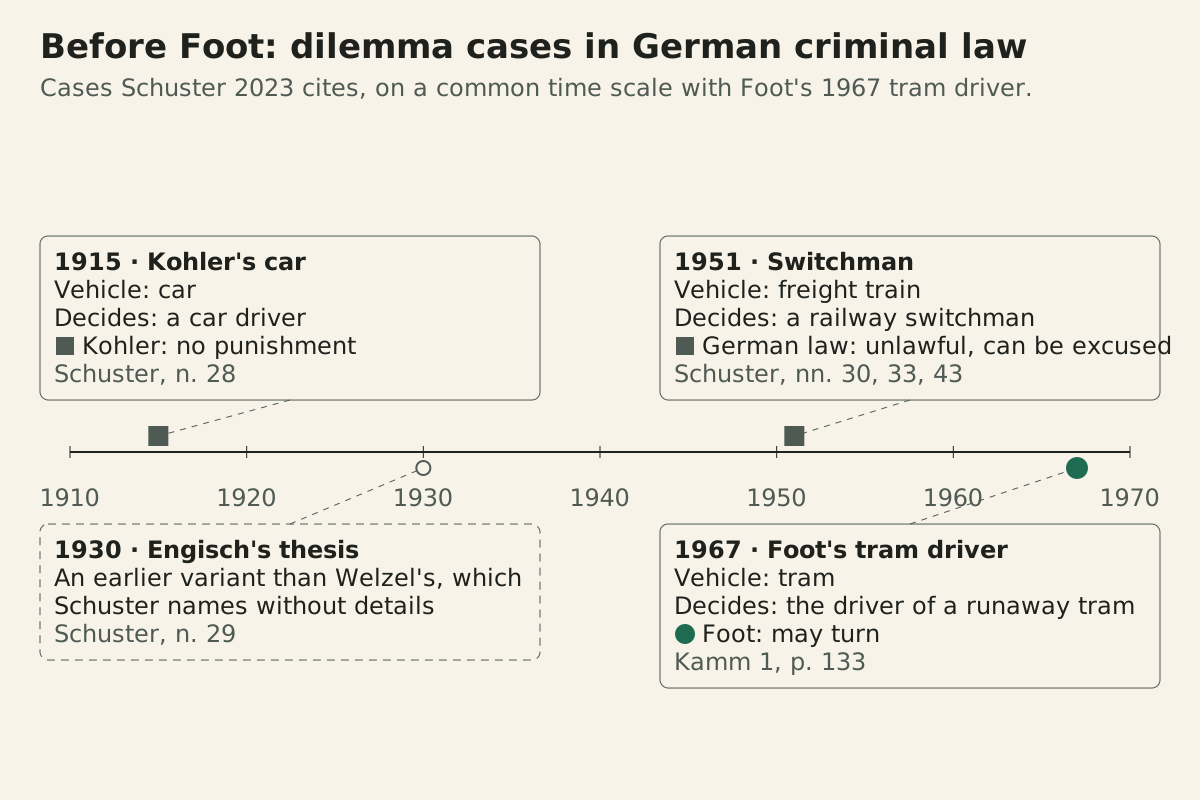
On this page's reading, that legal verdict sits closer to Thomson in 2008 than to Thomson in 1985, though criminal law and moral philosophy ask different questions.
Common retelling vs. the texts
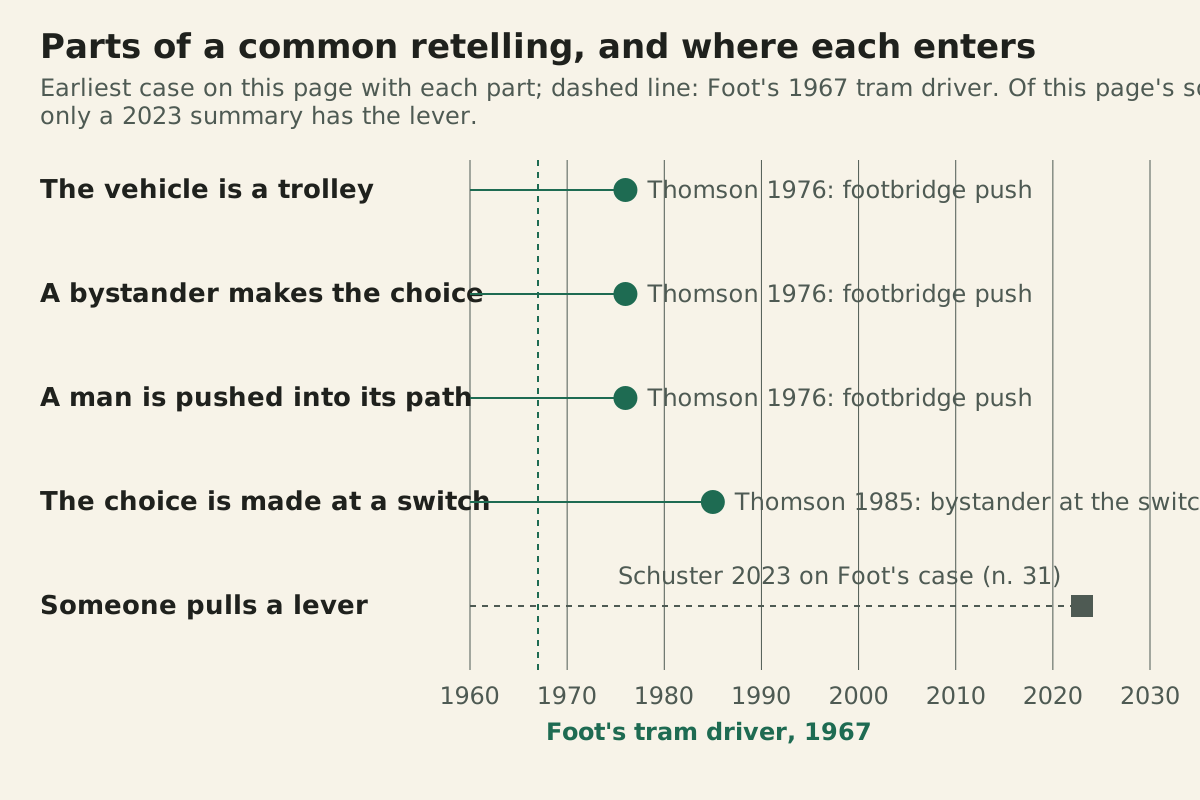
Set beside the sources above, a common retelling of the problem differs from them in four places.
| Common retelling | What the readable sources say |
|---|---|
| A bystander pulls a lever. | In Foot's case the driver turns the trolley (Kamm; SEP). Schuster's 2023 summary mentions a lever. Thomson's bystander at a switch dates to 1985 (Kamm; SEP) or 1986 (SEP, "Doing vs. Allowing Harm"). |
| Foot invented the man pushed in front of the trolley. | Kamm traces the push to Thomson's 1976 paper; the SEP and Schuster cite her 1985 paper. |
| The point is five lives against one. | Foot set the driver beside a judge and held that killing one was wrong for the judge but not for the driver (SEP). |
| The settled answer is to turn. | In 2008 Thomson argued that the bystander may not turn the trolley (SEP; Kamm). |
The chart below dates each part of the retelling to the earliest case on this page that has it.
What changes from one text to the next?
Read in order, with Kamm's dates, the texts change the case part by part. Foot sets a driver against a judge. In 1976 Thomson sets the driver against a surgeon, names the problem and adds a push. In 1985 she gives the choice to a bystander and bends the side track into a loop; in 2008 she lets the bystander turn the trolley onto himself.
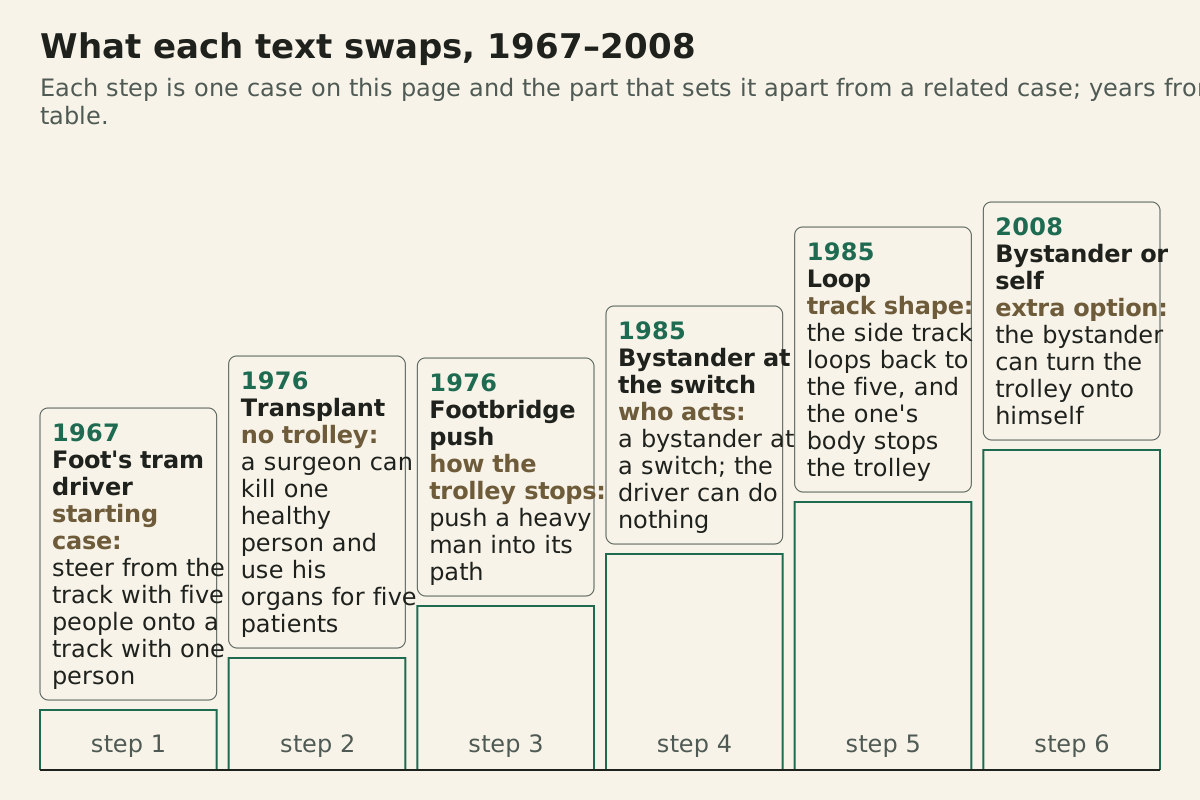
That dated record lets the trolley problem pass the dojo test, the site's gate for full entries: any retelling can be checked part by part against the text that added each part. On this site's view, the trolley problem has not been worn out; it has been taught badly, as one frozen scene instead of the sequence the texts built. All 26 cases are mapped part by part in trolley problem variations.
Next, take the version you first learned and date each of its parts.
Practice
Off the page:
A paper drill to finish within 24 hours:
- Write the trolley problem as you first heard it, in two or three sentences.
- Underline each part: who decides, what they can do, the vehicle, any lever or switch, any push.
- Beside each part, write the earliest text on this page that has it, using the charts or the case table (CSV, trolley-problem-original-version-cases.csv). Mark any part that no text on this page has.
- Pick the part that would change your verdict if it were removed, and write one sentence on why.
- Set your version beside the 26 cases in trolley problem variations, or try a puzzle with one checkable answer: the Hardest Logic Puzzle Ever.
Sources
- [1] Philippa Foot, "The Problem of Abortion and the Doctrine of the Double Effect," in Virtues and Vices (Oxford University Press, 2002), pp. 19–32; first published in Oxford Review 5 (1967). doi.org/10.1093/0199252866.003.0002 Consulted: bibliographic record only; the cases are summarized here through Kamm 2013 and the SEP entry "Doing vs. Allowing Harm"
- [2] Judith Jarvis Thomson, "Killing, Letting Die, and the Trolley Problem," The Monist 59(2): 204–217 (1976), doi:10.5840/monist197659224. doi.org/10.5840/monist197659224 Consulted: bibliographic record only; quoted and summarized here through Kamm 2013
- [3] Judith Jarvis Thomson, "The Trolley Problem," The Yale Law Journal 94(6): 1395–1415 (1985), doi:10.2307/796133. doi.org/10.2307/796133 Consulted: bibliographic record only; summarized and quoted here through Kamm 2013 and the SEP entry "Doctrine of Double Effect"
- [4] Judith Jarvis Thomson, "Turning the Trolley," Philosophy & Public Affairs 36(4): 359–374 (2008), doi:10.1111/j.1088-4963.2008.00144.x. doi.org/10.1111/j.1088-4963.2008.00144.x Consulted: bibliographic record only; the argument is summarized here through the SEP entry "Doing vs. Allowing Harm" and Kamm 2013
- [5] F. M. Kamm, "Lecture I. Who Turned the Trolley? Lecture II. How Was the Trolley Turned?," The Tanner Lectures on Human Values, delivered at the University of California, Berkeley, March 19–21, 2013, pp. 133–186. tannerlectures.org/documents/kamm-lecture/ Consulted: Lecture 1, pp. 133–149 and its notes on pp. 157–158; Lecture 2, pp. 167–169 and note 13, p. 185
- [6] Fiona Woollard, Frances Howard-Snyder and Charlotte Unruh, "Doing vs. Allowing Harm," Stanford Encyclopedia of Philosophy (substantive revision 2025-07-08). plato.stanford.edu/entries/doing-allowing/ Consulted: section 3 and the bibliography of the current entry, as of 2026-10-17
- [7] Alison McIntyre, "Doctrine of Double Effect," Stanford Encyclopedia of Philosophy (substantive revision 2023-07-17). plato.stanford.edu/entries/double-effect/ Consulted: the opening definition and sections 2 and 4.5 of the current entry, as of 2026-10-17
- [8] Frank Peter Schuster, "Coping with Moral Dilemmas in German Criminal Law Theory and Justice: Classical Cases and Modern Variants," Criminal Law Forum 34(2): 237–270 (2023), doi:10.1007/s10609-023-09452-0. doi.org/10.1007/s10609-023-09452-0 Consulted: full text; the section "Switchman Case (Weichenstellerfall) and the Trolley Problem", the section on German law that follows it, and their notes Text licence: CC BY 4.0
Cite this page
Virtue & Paradox. “Trolley Problem: Foot's Original Has a Driver, No Bystander.” Published 2026-10-17; last substantive revision 2026-10-17. https://virtueandparadox.com/dilemmas/trolley-problem-original-version/. Accessed (the date you read it).