Logic & ParadoxesThought experiment and dilemma variants
The Paradox Index: 9 Paradoxes, 5 With an Accepted Answer
Source card
Texts this entry reads, by coordinate and edition.
- Aristotle, Physics 6.9, 239b5–240a18R. P. Hardie and R. K. Gaye translation, The Works of Aristotle, vol. 2 (Oxford, 1930)Source [1] · open the text
- Diogenes Laertius, Lives of Eminent Philosophers 2.108R. D. Hicks translation (Loeb, 1925), Perseus digital edition, CC BY-SA 4.0Source [2] · open the text · Text licence: CC BY-SA 4.0
- Plato, Meno 80d–eBenjamin Jowett translation (Project Gutenberg #1643)section numbers as given in the IEP entry on the MenoSource [3] · open the text
- Lewis Carroll, "A Logical Paradox," Mind n.s. 3, no. 11 (1894), pp. 436–438journal printing, scan of the volumeSource [4] · open the text
- Lewis Carroll, "What the Tortoise Said to Achilles," Mind n.s. 4, no. 14 (1895), pp. 278–280journal printing, scan of the volumeSource [5] · open the text
Show 8 more, VI–XIIIHide VI–XIII
- IEP "Zeno's Paradoxes", secs. 2, 3.a and 5.bBradley Dowden; read 2026-10-17, no revision date shownSource [6] · open the text
- SEP "Zeno's Paradoxes", secs. 1.2, 3.1–3.4 and 5Nick Huggett; substantive revision 2024-03-06Source [7] · open the text
- IEP "Liar Paradox", opening summary and sec. 1Bradley Dowden; read 2026-10-17, no revision date shownSource [8] · open the text
- SEP "Liar Paradox", sec. 4Beall, Glanzberg, Ripley and Rossi; substantive revision 2026-07-26Source [9] · open the text
- SEP "Sorites Paradox", opening summary and secs. 1 and 3Raffman and Hyde; substantive revision 2025-08-26Source [10] · open the text
- IEP "Plato: Meno", sec. 2.bGlenn Rawson; read 2026-10-17, no revision date shownSource [11] · open the text
- IEP "Lewis Carroll: Logic", secs. 6.a and 6.bFrancine F. Abeles; read 2026-10-17, no revision date shownSource [12] · open the text
- SEP "Russell's Paradox", opening summary and secs. 1, 2.3–2.4 and 5Deutsch, Marshall and Irvine; substantive revision 2026-03-13Source [13] · open the text
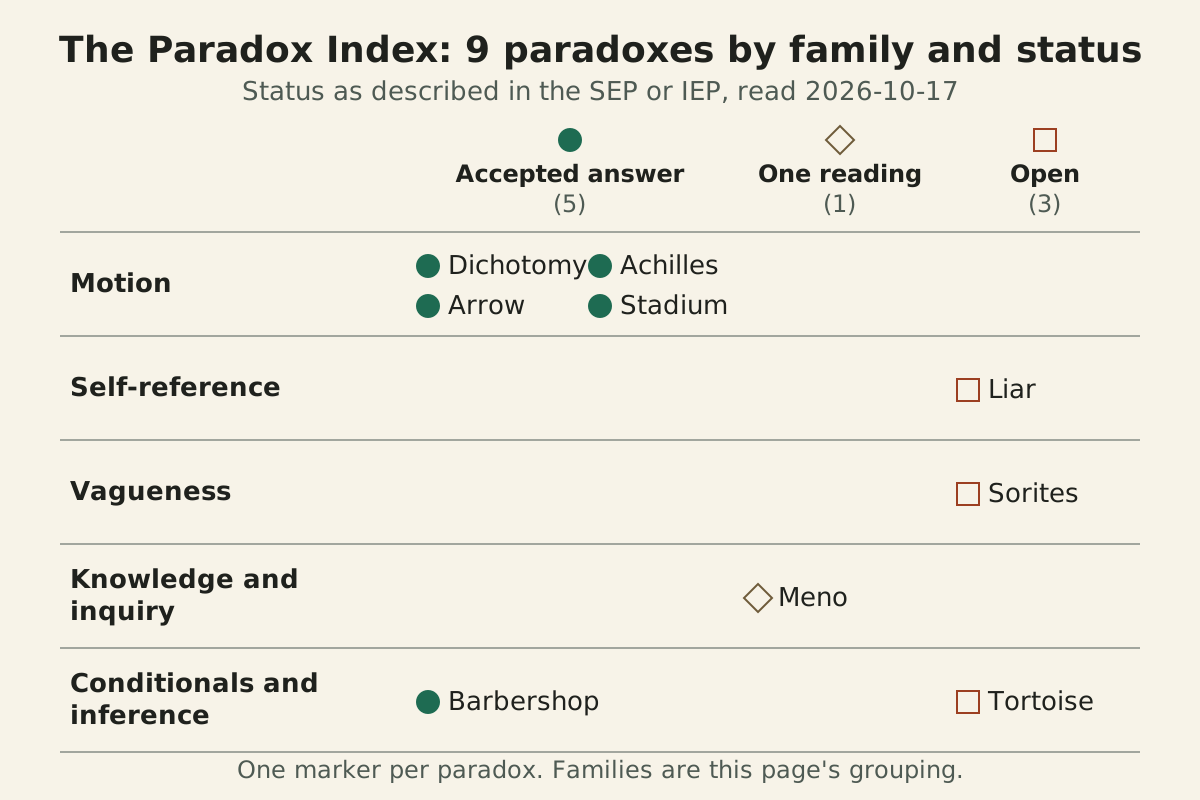
Zeno argued that swift Achilles can never overtake the slowest runner. Most experts now accept an answer to that, and the Paradox Index counts five such answers among its nine rows: Zeno's four arguments about motion and Lewis Carroll's barbershop paradox. The liar, the heap and Carroll's tortoise are still open, and Meno's paradox counts as answered only on one author's reading. Each row of this list of paradoxes gives the earliest text cited, a family and a status from the Stanford Encyclopedia of Philosophy (SEP) or the Internet Encyclopedia of Philosophy (IEP).
How does a paradox get a row?
A row needs three things. First, the earliest text cited must have a readable edition that is public domain in both the US and the EU, so you can open the coordinate yourself. Second, a current SEP or IEP entry must say how the paradox stands. This page reports that status, as read on 2026-10-17, and does not rule on it.
Third, the argument must survive translation. Probability puzzles, arguments that turn on English words and paradoxes about religious claims stay out.
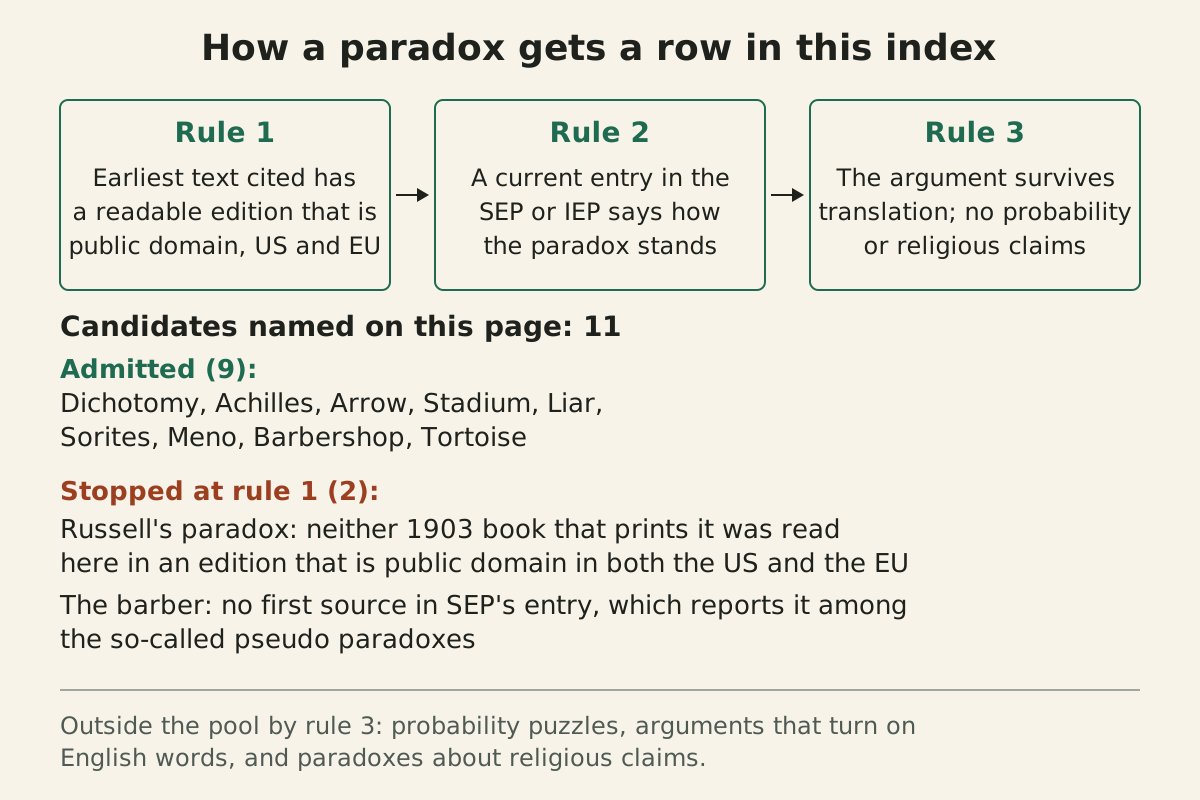
Russell's paradox stops at the first rule. The SEP entry dates Bertrand Russell's discovery to around 1901 and his letter about it to Gottlob Frege to June 16, 1902. In 1903 it appeared in Russell's The Principles of Mathematics and in an appendix to the second volume of Frege's Grundgesetze der Arithmetik. Neither book was read for this page in an edition that is public domain in both places.
The barber who shaves exactly those villagers who do not shave themselves stops there too. The same entry gives no first source for it and reports it among the "pseudo paradoxes," as they are sometimes called: its reasoning shows that no such barber exists.
Each admitted row is an argument whose steps you can lay out and check. That is how a paradox passes the dojo test, this site's gate for a full entry. Thought experiments such as the original trolley problem ask what someone may do, not whether an argument holds, so they stay out of this index.
The index, row by row
| Paradox | Family | Earliest text cited | Status (source) |
|---|---|---|---|
| Dichotomy (the racecourse) | Motion | Aristotle, Physics 6.9, 239b11–13 | Accepted answer (IEP, SEP) |
| Achilles and the tortoise | Motion | Aristotle, Physics 6.9, 239b14–18 | Accepted answer (IEP, SEP) |
| The arrow | Motion | Aristotle, Physics 6.9, 239b5–9 and 239b30–33 | Accepted answer (IEP, SEP) |
| The stadium (the moving rows) | Motion | Aristotle, Physics 6.9, 239b33–240a18 | Accepted answer (IEP, SEP) |
| The liar | Self-reference | Diogenes Laertius, Lives 2.108 | Open (IEP, SEP) |
| Sorites (the heap; the bald man) | Vagueness | Diogenes Laertius, Lives 2.108 | Open (SEP) |
| Meno's paradox | Knowledge and inquiry | Plato, Meno 80d–e | Answered on one reading (IEP) |
| Carroll's barbershop paradox | Conditionals and inference | Carroll, Mind n.s. 3 (1894), pp. 436–438 | Accepted answer (IEP) |
| Carroll's tortoise | Conditionals and inference | Carroll, Mind n.s. 4 (1895), pp. 278–280 | Open (IEP) |
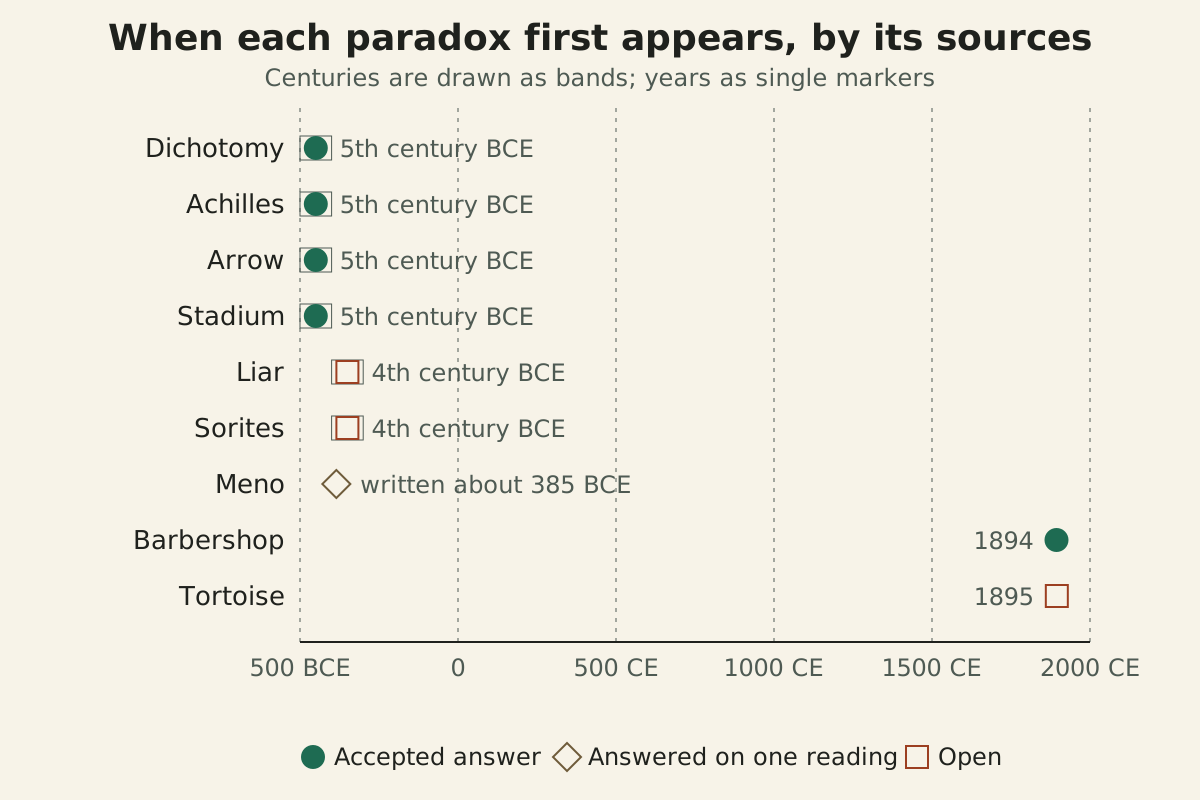
Zeno's four are the oldest paradoxes on the list. The IEP entry on the liar dates Zeno's paradoxes to the 5th century BCE and the liar to the middle of the 4th century BCE. The text cited for Zeno is Aristotle's Physics: as the SEP entry on Zeno notes, the paradoxes of motion are known from Aristotle, who set out to refute them.
 Generated illustration
Age does not predict status here. The liar comes from the century after Zeno's arguments and is still open, while Carroll's barbershop of 1894 has an accepted answer. The full index as a CSV file (CSV, paradox-index-rows.csv) adds the entry sections and reading dates behind every status. How Claims Are Tested sets out how sources are read and dated.
Has Zeno's paradox been solved?
By the standard most experts apply, yes. Bradley Dowden's IEP entry on Zeno's paradoxes reports "wide agreement among today's experts that there is at least one acceptable resolution." That resolution is the Standard Solution, built on calculus; by the entry's own definition, that agreement makes Zeno's paradoxes puzzles rather than paradoxes. Nick Huggett's SEP entry (revised 2024-03-06) calls the approach through modern mathematics the "received" view.
Both entries also record dissent. Some critics doubt that this mathematics describes physical space and time, and others ask whether infinitely many tasks can be completed at all.
Aristotle gives the Dichotomy as the claim that "that which is in locomotion must arrive at the half-way stage before it arrives at the goal" (Physics 6.9, 239b11–13, Hardie and Gaye translation) — verified. The runner must always cover half of what is left.
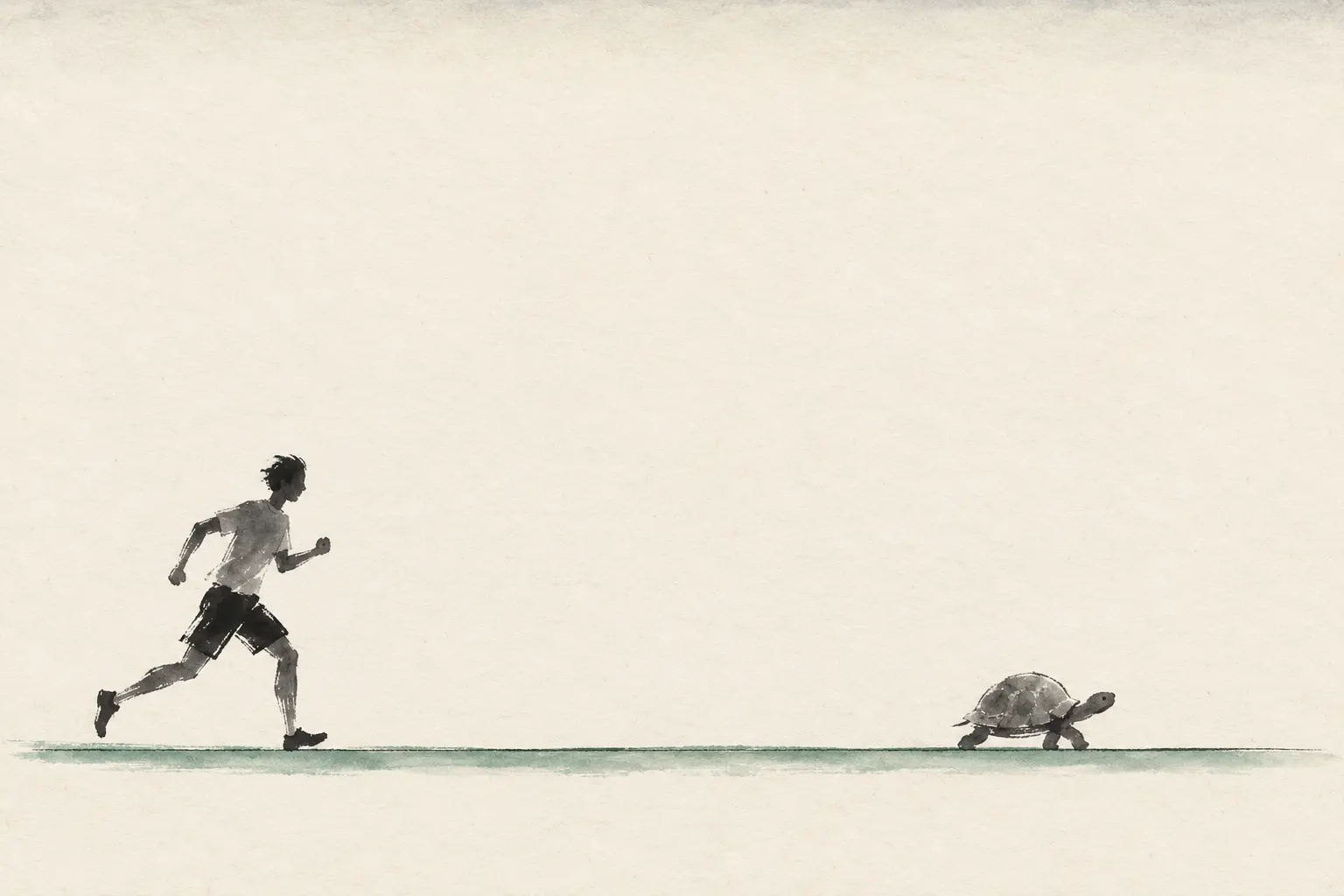
The Achilles applies the same idea to a chase: "in a race the quickest runner can never overtake the slowest" (Physics 6.9, 239b15–16, Hardie and Gaye translation) — verified. The SEP entry puts numbers on it. Achilles runs at 1 m/s, and the tortoise crawls at 0.1 m/s from a 0.9 m head start.
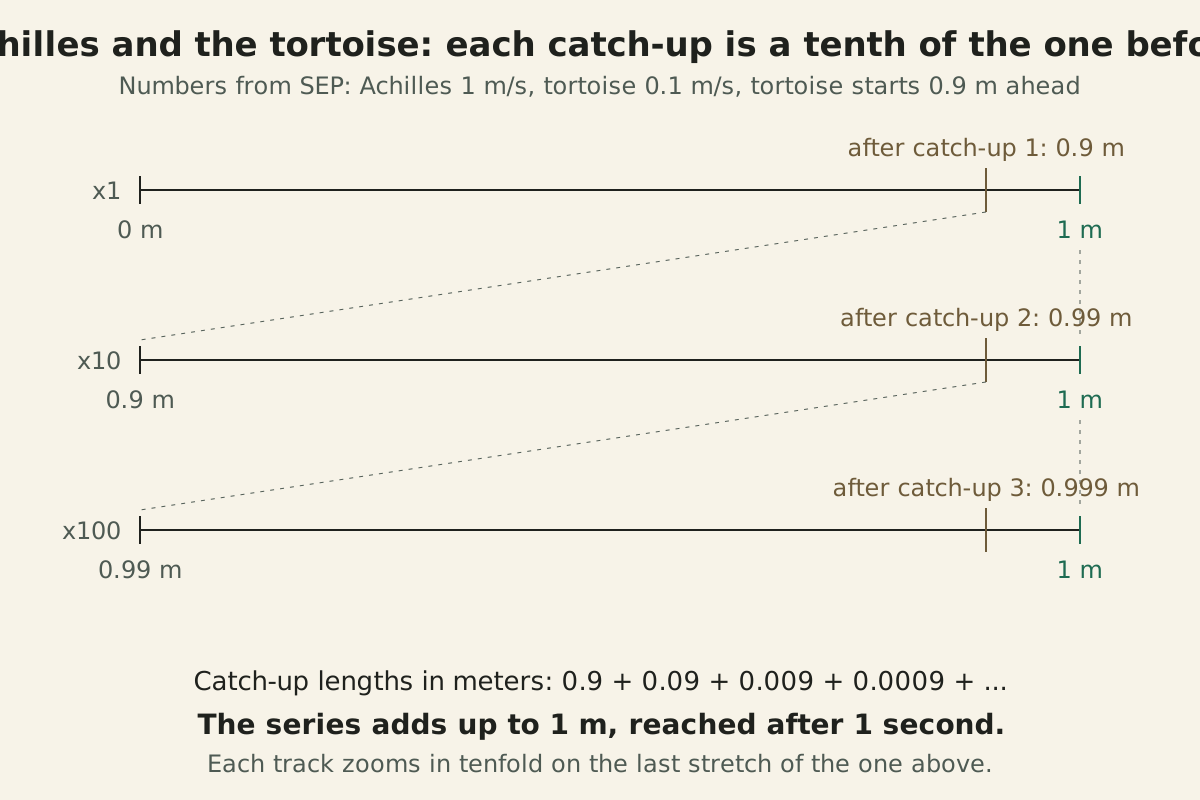
The arrow and the stadium get their answers by other routes. The IEP entry answers the arrow with the "at-at" theory: moving means being at different places at different times. On the stadium, it says that "Today's analysts agree with Aristotle's diagnosis," an error about relative speed; the SEP entry calls that diagnosis the "general verdict" and sets other readings beside it.

On the IEP's definition, the hardest logic puzzle ever and the Zebra Puzzle are puzzles too. Each has an answer checked case by case on this site.
The liar: still no agreed way out
The liar fits in one line: "This sentence is false." If it is true, what it says holds, so it is false. If it is false, what it says fails, so it is true. Diogenes Laertius credits Eubulides of Miletus with "many dialectical arguments in an interrogatory form," naming The Liar first (Lives 2.108, Hicks translation) — verified.
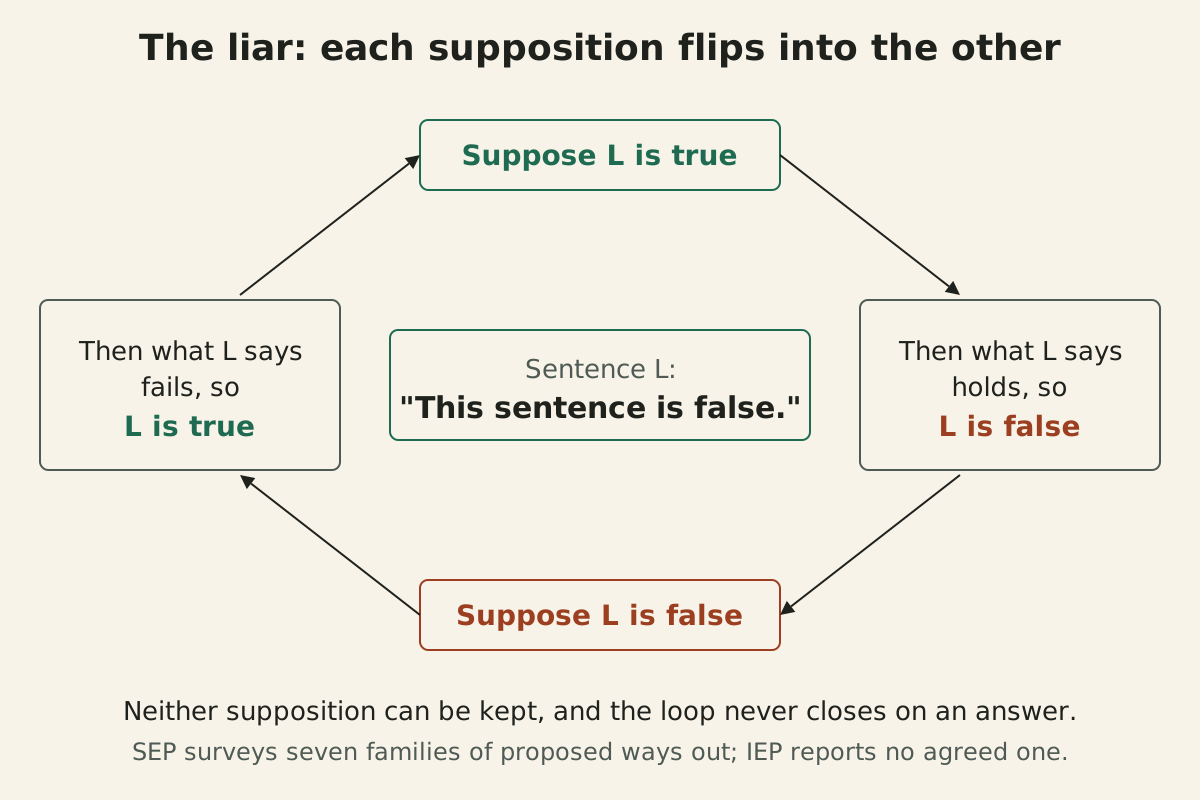
Dowden's IEP entry on the liar says experts "have never agreed on the way out of the trouble despite 2,300 years of attention." The SEP entry by Jc Beall, Michael Glanzberg, Ellie Ripley and Lorenzo Rossi (revised 2026-07-26) sorts the proposed solutions into families. By this page's count of its section headings there are seven, from changes to logic itself to theories of what makes a sentence paradoxical. The entry surveys them side by side and does not declare one correct.
The heap: one grain at a time
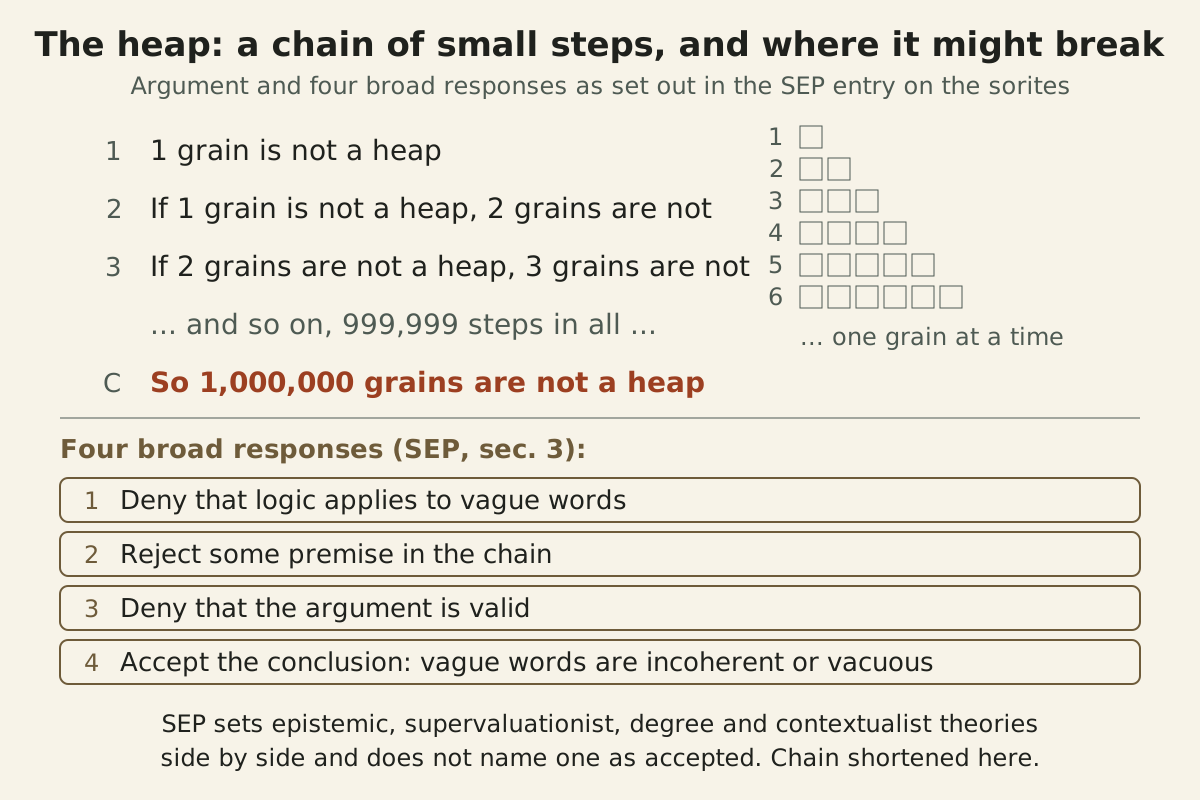
One grain of wheat is not a heap. Adding a single grain never seems to turn a non-heap into a heap. Run that step 999,999 times, as the SEP entry does, and 1,000,000 grains are still not a heap. Diogenes Laertius lists The Sorites and The Bald Head among the same arguments of Eubulides (Lives 2.108).
 Generated illustration
The SEP entry by Diana Raffman and Dominic Hyde (revised 2025-08-26) names "bald" and "heap" among its prime examples of vague terms. Most theorists of vagueness, it reports, think the paradox can be solved. The entry then sets out four broad responses: deny that logic applies to vague words, reject a premise, deny that the argument is valid, or accept that vague words are incoherent or empty.
Epistemic, supervaluationist, degree and contextualist theories each take a route through those options. The entry sets them side by side without naming one as accepted, so this row reads open.
Meno's paradox: answered inside the dialogue?
Meno's paradox asks how you can search for something you do not know. Socrates restates the objection in Plato's Meno: "You argue that a man cannot enquire either about that which he knows, or about that which he does not know" (Meno 80e, Jowett translation) — verified. Socrates answers with a geometry lesson in which an uneducated slave reaches a correct answer through questions.
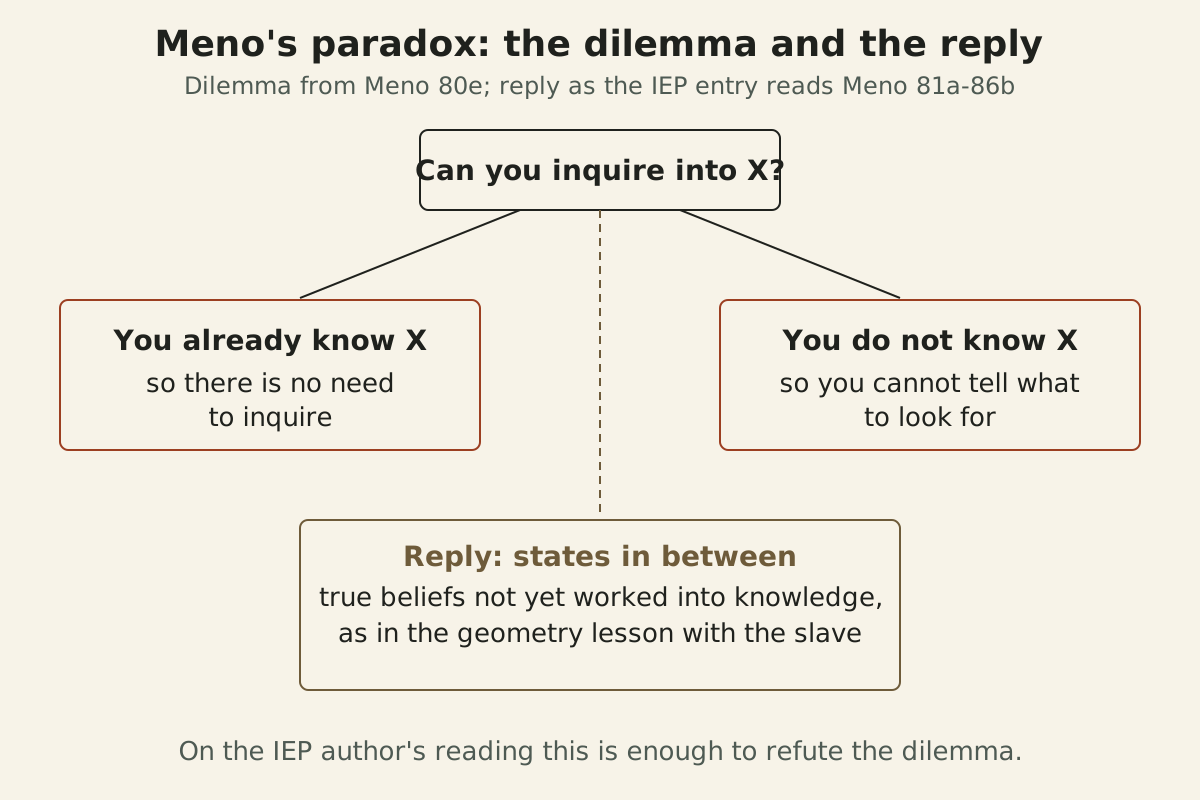
Glenn Rawson's IEP entry on the Meno reads that lesson as showing states between complete knowledge and pure ignorance. One such state is a true belief not yet worked into knowledge. The entry concludes: "That is enough to refute Meno's Paradox." It also notes that Socrates disclaims confidence about the details of his theory of recollection.
This is one author's reading, not a reported consensus, so the row says "answered on one reading."
Carroll's barbershop and tortoise
Lewis Carroll published two short paradoxes in the journal Mind. They now sit on opposite sides of the index. In "A Logical Paradox" (1894), two uncles argue over whether the barber Carr will be in the shop. Carroll's closing note reduces the dispute to two rules: "If Carr is out, then, if Allen is out, Brown is in" and "If Allen is out, Brown is out" (Mind n.s. 3, p. 438) — verified.
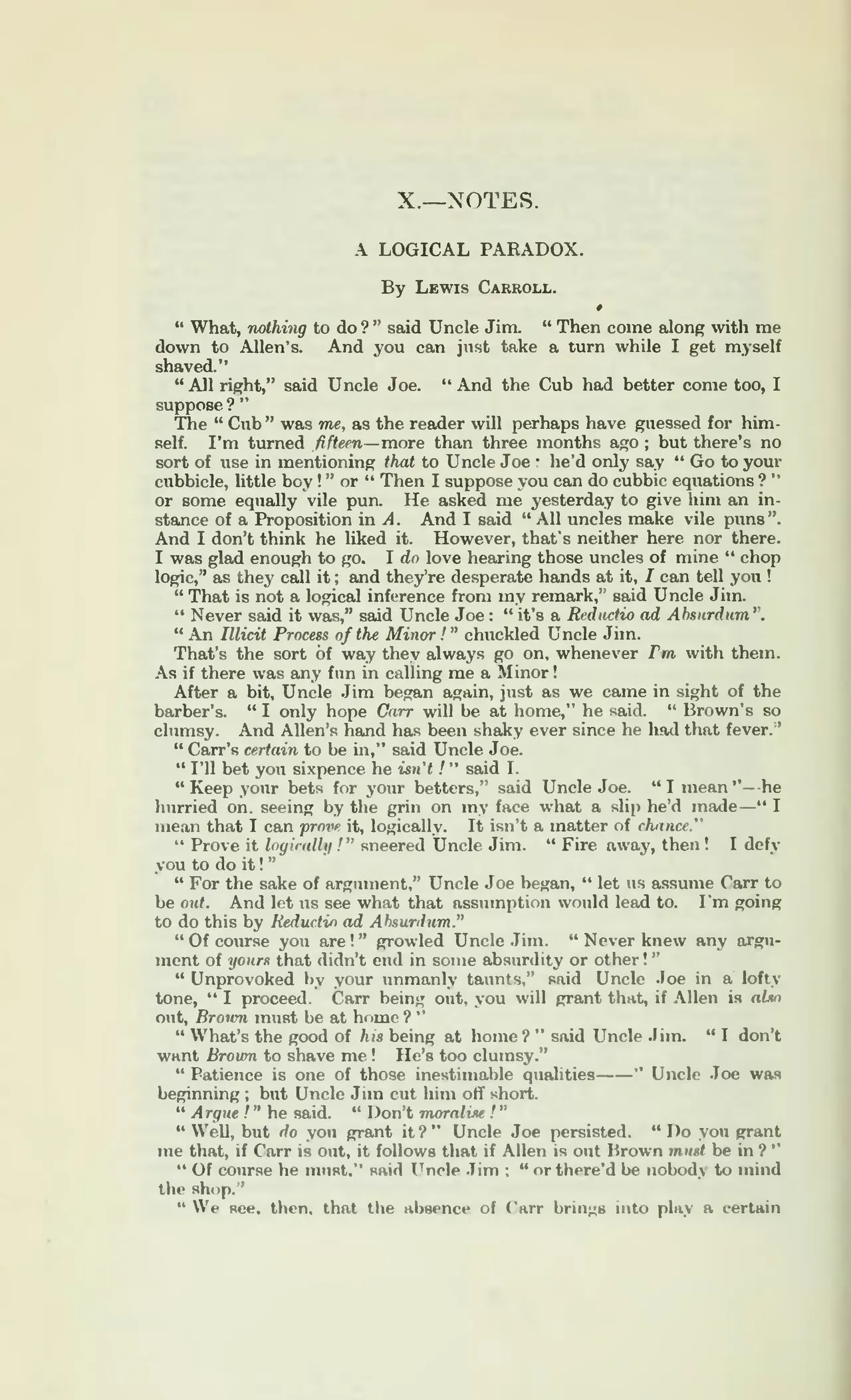
Carroll called it "a very real difficulty in the Theory of Hypotheticals" (Mind n.s. 3, p. 438) — verified. Francine F. Abeles's IEP entry on Carroll's logic says Russell gave "what is now the generally accepted conclusion" in 1903: if Carr is out, Allen is in. This puzzle about conditionals differs from the self-shaving barber stopped at the first rule above.
A year later came "What the Tortoise Said to Achilles" (1895). It begins after the race, with Achilles seated on the Tortoise's back. The Tortoise accepts two premises but not the conclusion, and asks for each linking rule as one more premise. Achilles writes C, D and E into his notebook, and months later the count stands at "a thousand and one" (Mind n.s. 4, p. 280) — verified.
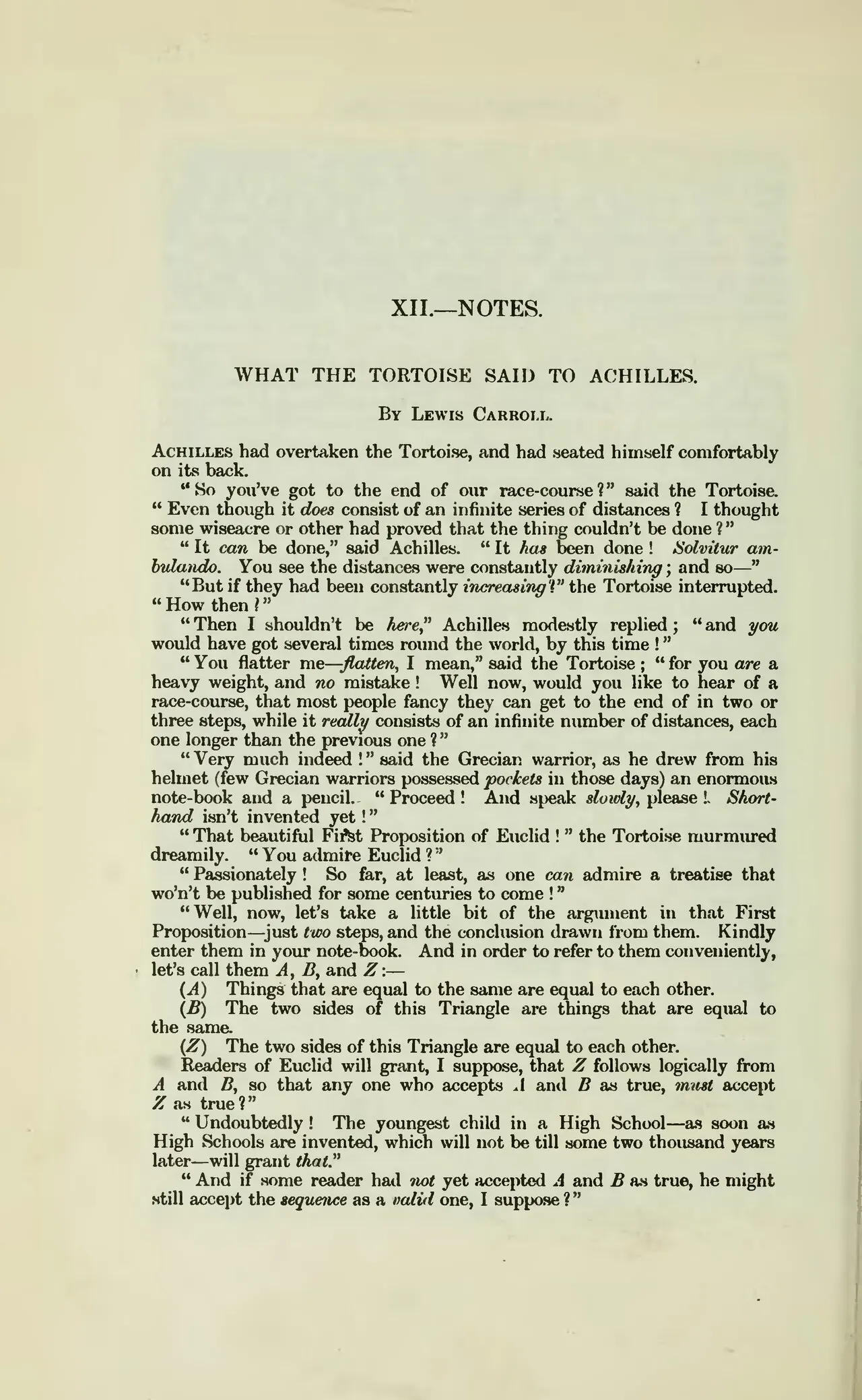
The IEP entry says Carroll's tortoise "remains an unsolved problem to the current day." The barbershop's two rules are short enough to test by hand, so the drill below starts there.
Practice
Off the page:
A drill for the next 24 hours, on paper:
- Copy Carroll's two rules from page 438 of the 1894 note.
- Draw a four-row table for Carr out or in and Allen out or in. Mark each row where some choice for Brown lets both rules hold.
- Set your marks beside Russell's conclusion, if Carr is out, Allen is in, and write one line on whether they agree.
- Take the liar or the heap, write its argument as numbered steps, and note which step each response named in the SEP entry gives up.
- For contrast, run one case through the checked solution of the hardest logic puzzle ever. Or set these arguments beside trolley problem variations, where each case asks what someone may do.
Sources
- [1] Aristotle, Physics, trans. R. P. Hardie and R. K. Gaye, in The Works of Aristotle, vol. 2, ed. W. D. Ross (Oxford: Clarendon Press, 1930). archive.org/details/workstranslatedi02arisuoft Consulted: Book 6, chapter 9 (239b5–240a18), and the title page
- [2] Diogenes Laertius, Lives of Eminent Philosophers, trans. R. D. Hicks, Loeb Classical Library, 2 vols. (Cambridge, MA: Harvard University Press; London: William Heinemann, 1925); digital edition urn:cts:greekLit:tlg0004.tlg001.perseus-eng2, Perseus Digital Library, PerseusDL/canonical-greekLit (GitHub, commit 0189b9c), CC BY-SA 4.0 github.com/PerseusDL/canonical-greekLit/blob/0189b9c8d8d1f148133f2f0af309b4ee90ea4332/data/tlg0004/tlg001/tlg0004.tlg001.perseus-eng2.xml Consulted: Book 2, section 108 Text licence: CC BY-SA 4.0
- [3] Plato, Meno, trans. Benjamin Jowett, Project Gutenberg eBook #1643. www.gutenberg.org/ebooks/1643 Consulted: full text; the exchange at 80d–e read
- [4] Lewis Carroll, "A Logical Paradox," Mind n.s. 3, no. 11 (1894): 436–438. commons.wikimedia.org/wiki/File:Mind_(New_Series)_Volume_3.djvu Consulted: pages 436–438 in a scan of the journal volume
- [5] Lewis Carroll, "What the Tortoise Said to Achilles," Mind n.s. 4, no. 14 (1895): 278–280. commons.wikimedia.org/wiki/File:Mind_(New_Series)_Volume_4.djvu Consulted: pages 278–280 in a scan of the journal volume
- [6] Bradley Dowden, "Zeno's Paradoxes," Internet Encyclopedia of Philosophy, ISSN 2161-0002. iep.utm.edu/zenos-paradoxes/ Consulted: sections 2 and 3.a (the four paradoxes of motion), 5.b and 6; the page shows no revision date
- [7] Nick Huggett, "Zeno's Paradoxes," Stanford Encyclopedia of Philosophy, first published 2002-04-30, substantive revision 2024-03-06. plato.stanford.edu/entries/paradox-zeno/ Consulted: opening summary and sections 1.2, 3.1–3.4 and 5
- [8] Bradley Dowden, "Liar Paradox," Internet Encyclopedia of Philosophy, ISSN 2161-0002. iep.utm.edu/liar-paradox/ Consulted: opening summary and sections 1–3; the page shows no revision date
- [9] Jc Beall, Michael Glanzberg, Ellie Ripley and Lorenzo Rossi, "Liar Paradox," Stanford Encyclopedia of Philosophy, first published 2011-01-20, substantive revision 2026-07-26. plato.stanford.edu/entries/liar-paradox/ Consulted: opening summary and sections 3–5
- [10] Diana Raffman and Dominic Hyde, "Sorites Paradox," Stanford Encyclopedia of Philosophy, first published 1997-01-17, substantive revision 2025-08-26. plato.stanford.edu/entries/sorites-paradox/ Consulted: opening summary and sections 1 and 3
- [11] Glenn Rawson, "Plato: Meno," Internet Encyclopedia of Philosophy, ISSN 2161-0002. iep.utm.edu/meno-2/ Consulted: sections 1.c, 2.b and 3; the page shows no revision date
- [12] Francine F. Abeles, "Lewis Carroll: Logic," Internet Encyclopedia of Philosophy, ISSN 2161-0002. iep.utm.edu/lewis-carroll-logic/ Consulted: opening summary and sections 6 and 10.a; the page shows no revision date
- [13] Harry Deutsch, Oliver Marshall and Andrew David Irvine, "Russell's Paradox," Stanford Encyclopedia of Philosophy, first published 1995-12-08, substantive revision 2026-03-13. plato.stanford.edu/entries/russell-paradox/ Consulted: opening summary and sections 1, 2, 4 and 5
Cite this page
Virtue & Paradox. “The Paradox Index: 9 Paradoxes, 5 With an Accepted Answer.” Published 2026-10-17; last substantive revision 2026-10-17. https://virtueandparadox.com/puzzles/paradox-index/. Accessed (the date you read it).