Ethical DilemmasThought experiment and dilemma variants
Trolley Problem Variations: 18 of 26 Keep Five vs. One
Source card
Texts this entry reads, by coordinate and edition.
- Kamm 2013, Lecture 1, pp. 133–159Tanner Lectures on Human Values, University of California, Berkeley, March 19–21, 2013Source [1] · open the text
- Kamm 2013, Lecture 2, pp. 160–186Tanner Lectures on Human Values, University of California, Berkeley, March 19–21, 2013Source [1] · open the text
- Foot's tram driver, judge and gas casesas reported in Kamm 2013, Lecture 1, pp. 133 and 136, and SEP "Doing vs. Allowing Harm", sec. 3Source [2] · open the text
- The Monist 59(2), p. 206: the driver Edward and the surgeon Davidas quoted in Kamm 2013, Lecture 1, n. 2Source [3] · open the text
- Yale Law Journal 94(6), p. 1397: Bystander at the Switchas cited in Kamm 2013, Lecture 1, n. 8Source [4] · open the text
Show 5 more, VI–XHide VI–X
- Yale Law Journal 94(6): Loop Caseas cited in Kamm 2013, Lecture 2, n. 13Source [4] · open the text
- Philosophy & Public Affairs 36(4), p. 364: Bystander's Three-Option Caseas cited in Kamm 2013, Lecture 1, n. 15Source [5] · open the text
- Schuster 2023, section "Switchman Case (Weichenstellerfall) and the Trolley Problem", nn. 28, 30, 33, 43Criminal Law Forum 34 (2023), CC BY 4.0Source [6] · open the text · Text licence: CC BY 4.0
- SEP "Doctrine of Double Effect", opening summary and secs. 2 and 4.5substantive revision 2023-07-17Source [7] · open the text
- SEP "Doing vs. Allowing Harm", sec. 3substantive revision 2025-07-08Source [8] · open the text
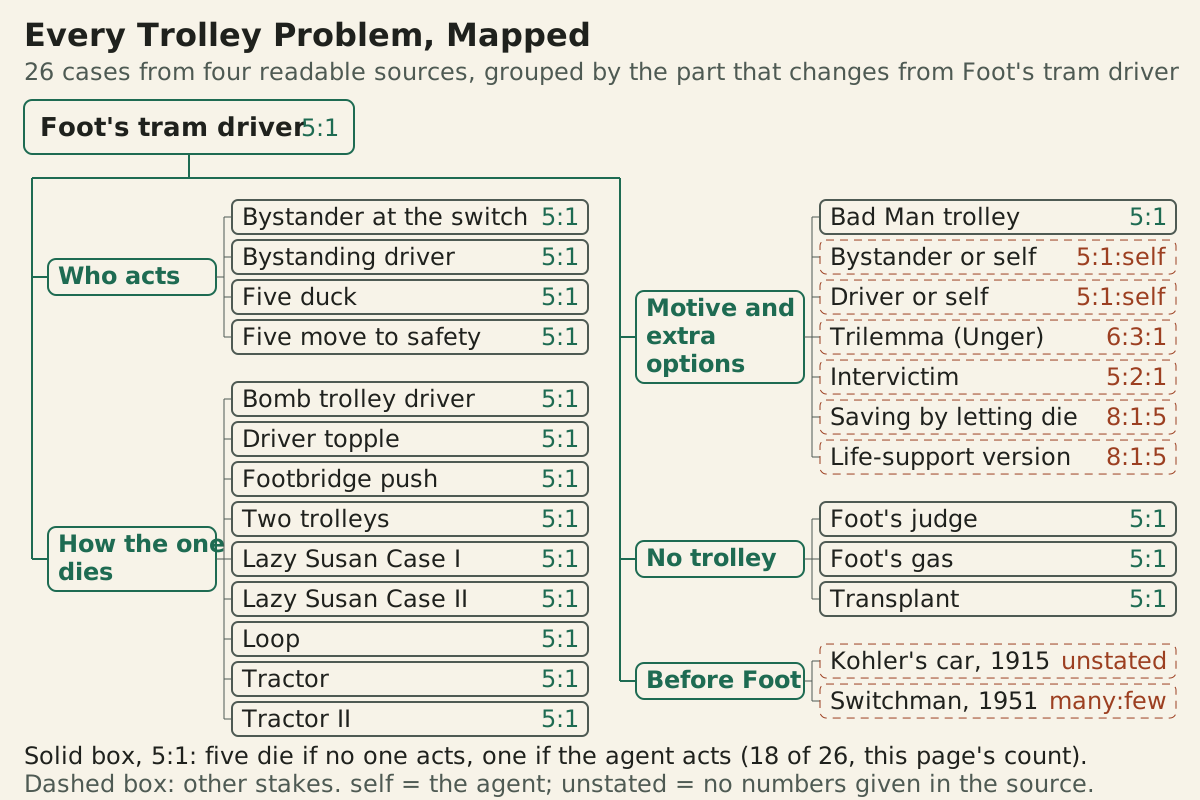
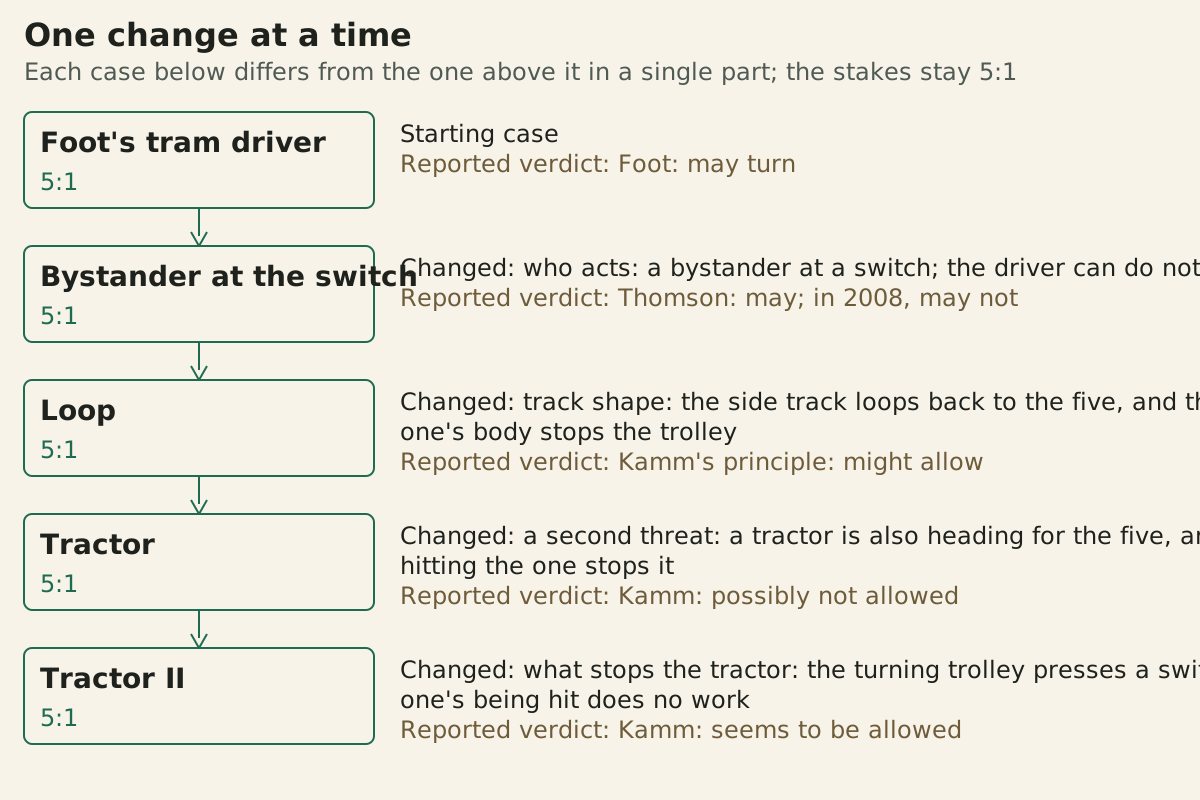
Of the 26 cases on this map, 18 still trade five lives for one. Most trolley problem variations in these sources keep that arithmetic and change one other part: who acts, how the one person dies, or what else the agent could do. The switch and the footbridge differ only in how the one dies. The loop changes only the shape of the track.
How to read the map
The cases come from F. M. Kamm's 2013 Tanner Lectures, two entries in the Stanford Encyclopedia of Philosophy (SEP) and a 2023 article on German criminal law. The map starts from six cases: Philippa Foot's tram driver, the judge and the gas case she set beside it, the transplant surgeon, and two German cases from 1915 and 1951 that the 2023 article treats as very similar to Foot's. It then adds every trolley case that Kamm or the SEP gives a proper name or a figure, 20 in all. Cases they describe without a name or a figure stay off, such as five people on each track (SEP, "Doing vs. Allowing Harm," sec. 3).
The map groups the cases by the kind of part that changes, and the downloadable case table names the case each one changes. A case keeps five vs. one when its source gives exactly two outcomes: five people die if no one acts, and one dies if the agent acts. By this page's count, 18 of the 26 do. The other 8 have different stakes, set out in the sections on third options and on the cases before Foot.
The papers by Foot and Thomson are summarized here as Kamm and the SEP report them, and How Claims Are Tested explains how this site weighs sources that disagree. The history of the starting case is traced in the original trolley problem. The Zebra Puzzle entry runs the same one-change check on its clues. On this site's reading, the trolley problem is taught badly when a lesson stops at the switch, since the testing happens in the cases that follow.
Who is at the controls?
Foot's tram driver can steer from five people toward one. On her view he may, because doing nothing would also be killing: his tram would run into the five. A judge who could save five people from a riot only by framing and killing one innocent man would merely let the five die if he refused. So for Foot the judge may not kill, as the SEP entry "Doing vs. Allowing Harm" sums up her pair of cases (sec. 3).

Judith Jarvis Thomson moved the controls to a bystander at a switch, who would only let the five die by doing nothing. If he may still turn the trolley, as she first held, the line between killing and letting die cannot be the whole answer (Kamm, Lecture 1, p. 139). Kamm and the SEP entry "Doctrine of Double Effect" tie the bystander case to Thomson's 1985 paper in the Yale Law Journal. The entry "Doing vs. Allowing Harm" writes "Thomson (1986)" instead, citing a 1986 book chapter that has the same title as a 1976 paper of hers in The Monist.
In 2008 Thomson reversed herself and argued that the bystander may not turn the trolley after all (Kamm, p. 141). Kamm adds a case in between. Her driver, thrown from the trolley, ends up near a switch, so he would now only let the five die, and she judges that he may still turn it (p. 139). Her last change hands the controls to the five, who may duck or run even though the trolley then hits the one person behind them (Lecture 2, p. 179).
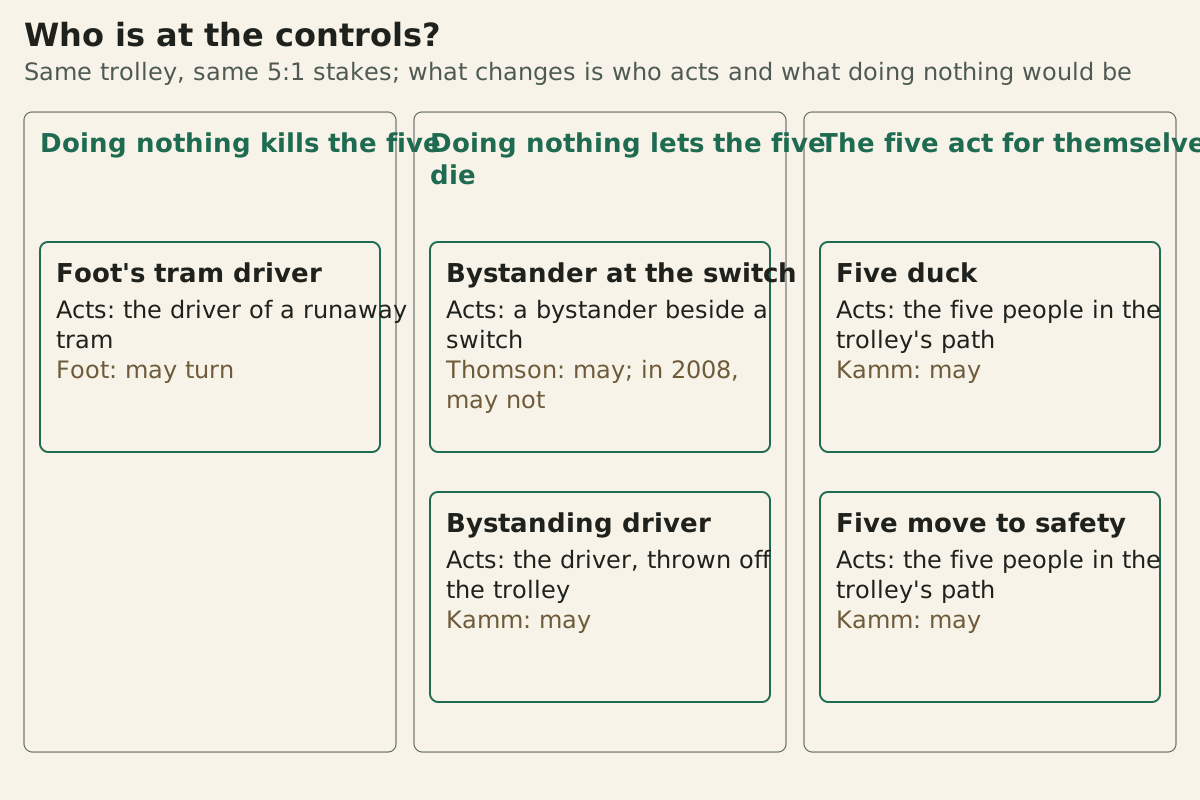
Kamm concludes that knowing who acted usually does not settle a case; what matters is "how the trolley was turned rather than by whom it was turned" (Lecture 1, pp. 153, 157).
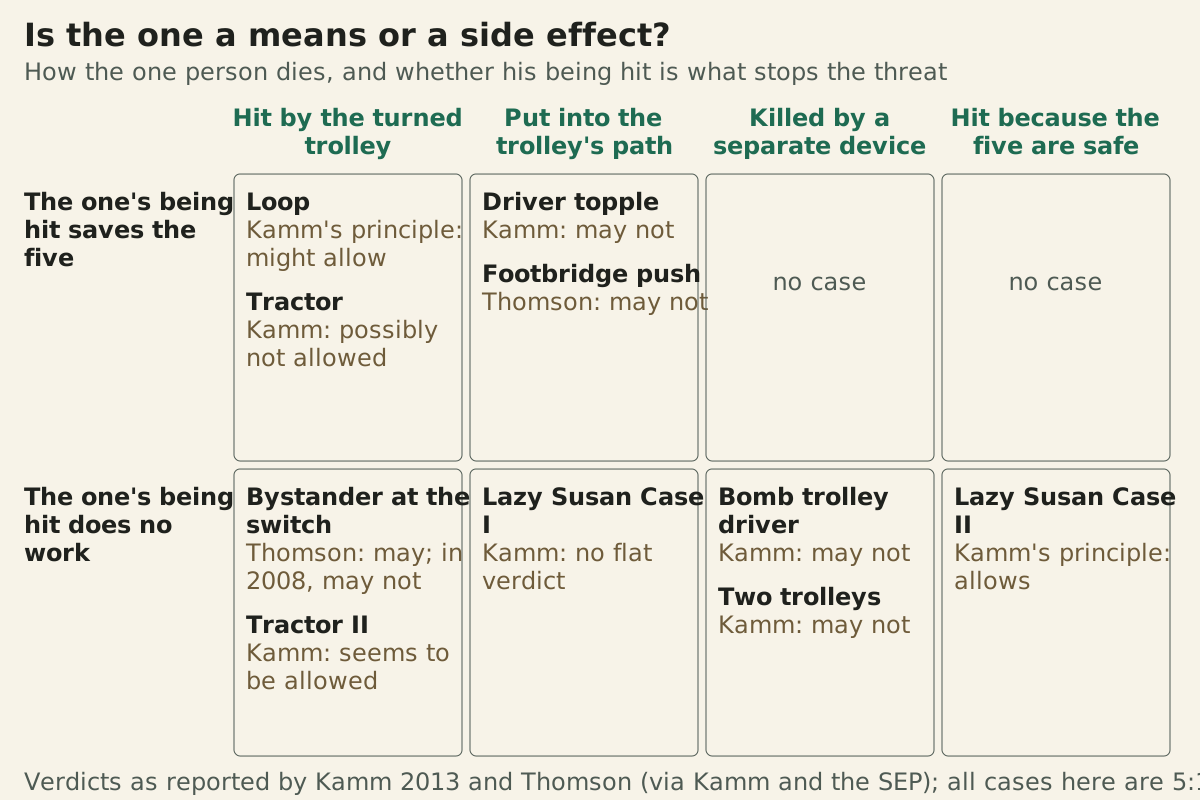
Is the one a means or a side effect?
One part separates the switch from the footbridge. At the switch, the turned trolley runs into the one person. On the footbridge, a heavy man is pushed into the trolley's path, and his body is what stops it. The SEP says the difference "might seem to depend on whether the death of that person is a means to saving the five or a side effect of doing so" ("Doctrine of Double Effect," sec. 4.5).
 Generated illustration
That is the doctrine of double effect: a harm you may not cause as a means can sometimes be caused as a foreseen side effect. The entry adds that this alone does not justify switching. Kamm's Driver Topple Case drops the push, since a device topples the man, and she judges it as wrong as the transplant case (Lecture 1, p. 138).
In Thomson's Loop Case, as Kamm describes it, the side track curves back toward the five, and the trolley stops only because it hits the one person. His being hit does the saving. Yet Kamm's proposed principle might still allow turning, since the turn itself moves the threat away (Lecture 2, pp. 168–169). In her Tractor Case, a tractor that the one person's body will stop is also heading for the five, and she suggests turning may then be wrong; in Tractor Case II the trolley stops the tractor by pressing a switch, and turning seems permissible to her (pp. 169–171).
Other cases move the harm off the turned trolley. In the Two-Trolleys Case a second trolley knocks the first away and kills someone on its way, which Kamm's principle rules out. Her principle allows Lazy Susan Case II, in which the five are spun to safety and rocks set loose by their arrival kill the one (pp. 163–168).
Third options and other numbers
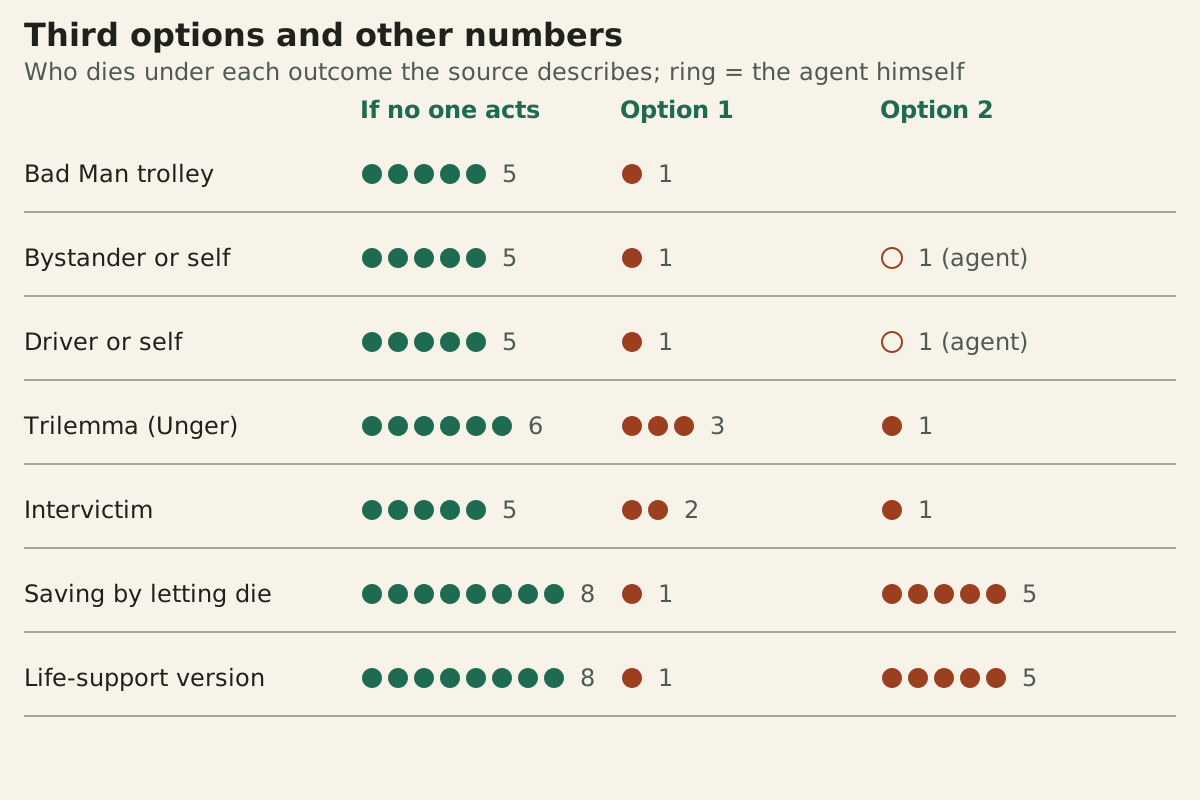
Seven cases change the motive or the options, and six of them break the five-against-one count. In Thomson's Bystander's Three-Option Case of 2008, the bystander could also turn the trolley onto himself. If he would not take that option, she argued, he may not turn it onto a stranger either (SEP, "Doing vs. Allowing Harm," sec. 3). Kamm replies that refusing a cost yourself does not by that fact alone forbid putting it on someone else (Lecture 1, pp. 144–145).
Peter Unger's Trilemma Case, which Kamm cites, turns a trolley from six people toward three, or toward one person who may be the agent himself (n. 15). Kamm's Saving-by-Letting-Die Case puts eight people on the main track, and the bystander can turn toward one person or block his own path to five others. She holds that he should block the path (pp. 153–154). In her Intervictim/Agent-Victim Case, toppling two people by turning could be permissible where toppling one to stop the trolley is not (Lecture 2, p. 174).
Only the Bad Man Trolley Case keeps the count. Its driver turns because the one person on the side track is his enemy, and Kamm reports it as a case used to argue that a bad motive alone does not make turning wrong (Lecture 1, p. 136).
No trolley at all, and the cases before Foot
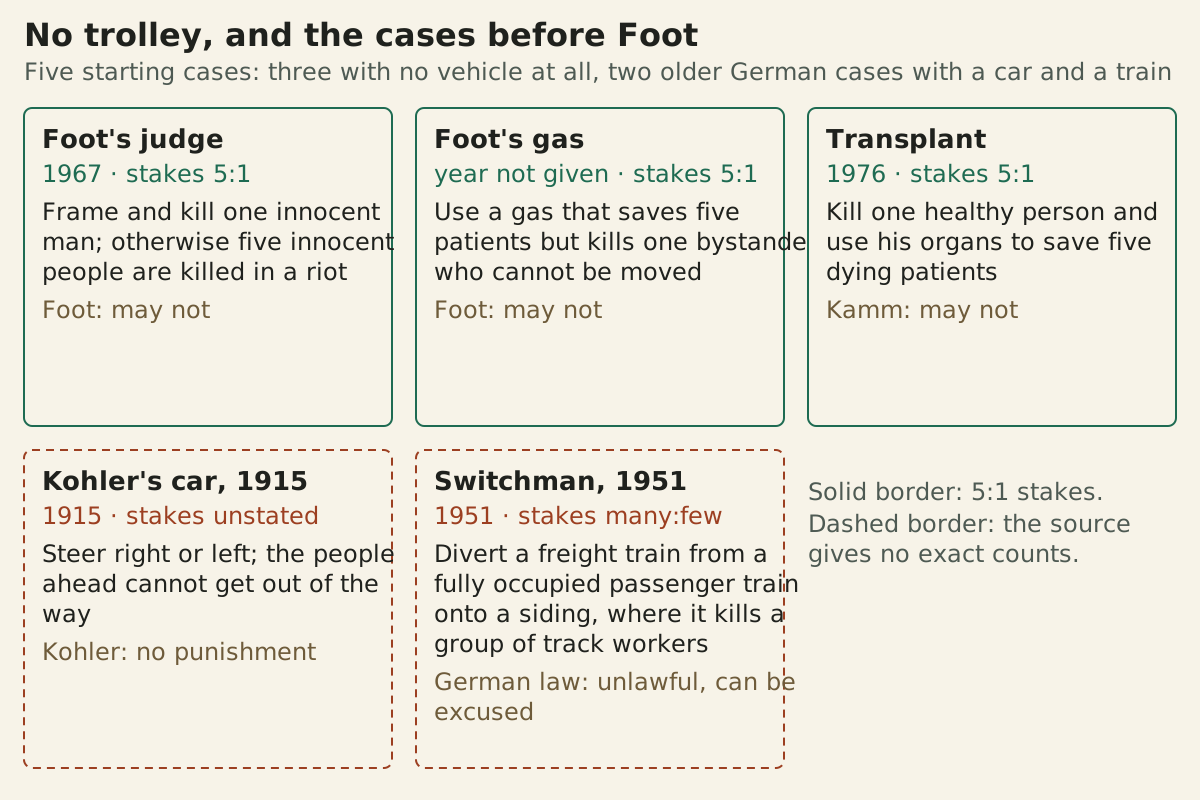
Three starting cases have no trolley. Besides Foot's judge, Kamm reports her gas case, in which a gas that would save five patients kills a bystander, and Foot judged it impermissible (p. 136). The transplant surgeon could kill one healthy person and use his organs for five patients, and Thomson set him against the driver in 1976 (n. 2). Here he stays a thought experiment, not guidance for medicine.
The two German cases are older. Josef Kohler's 1915 driver cannot stop his car and can only steer right or left, with people ahead who cannot get out of the way. Hans Welzel's 1951 switchman sends a freight train away from a full passenger train into track workers. Frank Peter Schuster's 2023 article reports that German criminal law treats that diversion as unlawful, though on the major academic view the switchman can be excused.
 Generated illustration
What each variant tests
The doctrine of double effect explains only part of this map. The SEP entry sorts the trolley debate into three camps ("Doctrine of Double Effect," sec. 4.5). One camp reads the switch-and-push pair as evidence that the line between means and side effects guides moral judgment. A second denies that the bystander may switch at all, and a third denies that double effect can explain the switch.
Foot's gas case already strains the doctrine, since the harm there is a side effect and Foot still judged the act wrong (Kamm, Lecture 1, p. 136). The chart below tags each case with the question its source uses it to test. Killing versus letting die runs through the cases about who acts and through German law, while most of Kamm's second lecture is about how the harm comes about. Unlike the paradoxes in the Paradox Index, these cases ask what someone may do, not what is true.
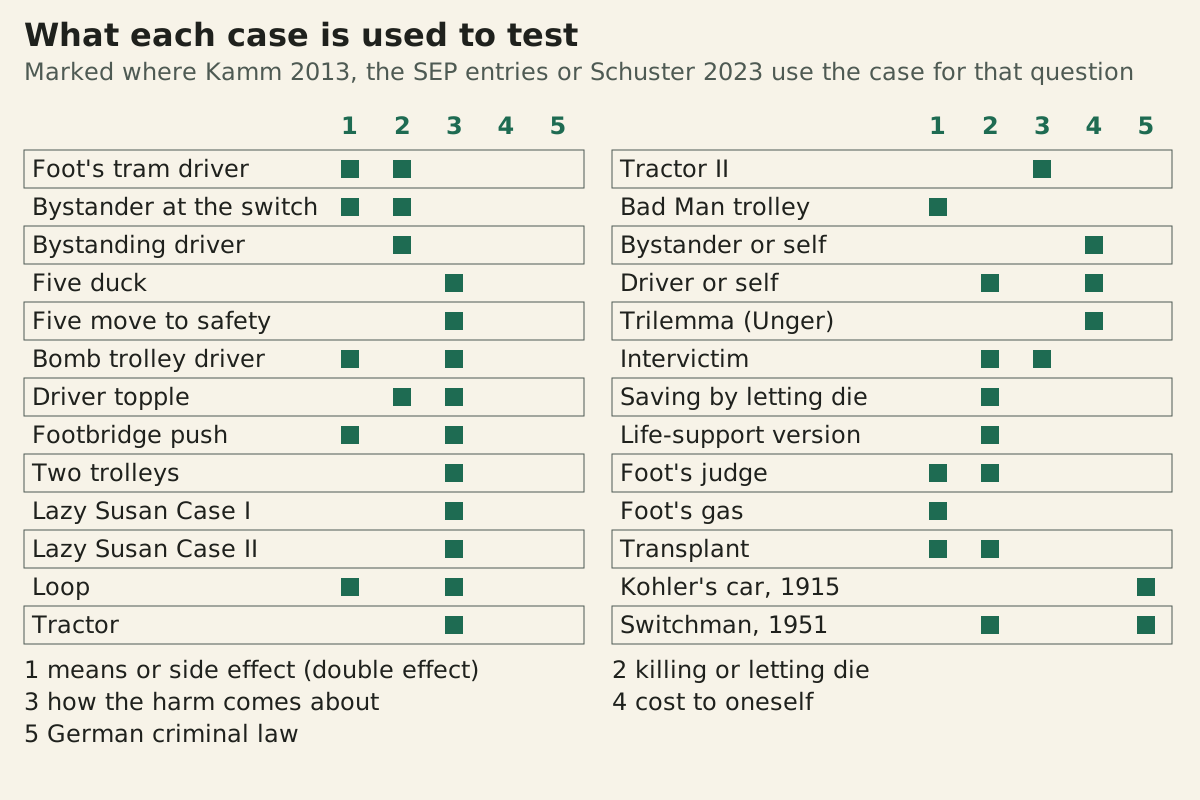
The table gives the details for every case, with a page to read. Kamm 1 and 2 are her two lectures, and "Doing vs. Allowing" and "Double Effect" are the two SEP entries.
| Case | What changes | Stakes | Used to test | Verdict as reported | Where |
|---|---|---|---|---|---|
| Foot's tram driver | starting case | 5:1 | killing or letting die; means or side effect (double effect) | Foot: may turn | Kamm 1, pp. 133, 136; SEP Doing vs. Allowing, sec. 3 |
| Bystander at the switch | who acts: a bystander at a switch; the driver can do nothing | 5:1 | killing or letting die; means or side effect (double effect) | Thomson: may; in 2008, may not | Kamm 1, pp. 139-141; SEP Doing vs. Allowing, sec. 3 |
| Bystanding driver | who acts: the driver, thrown from the trolley, now stands at a switch | 5:1 | killing or letting die | Kamm: may | Kamm 1, p. 139 |
| Five duck | who acts: the five themselves, standing in front of one person | 5:1 | how the harm comes about | Kamm: may | Kamm 2, p. 179 |
| Five move to safety | how the one dies: the five reach a safe area, which sets off a rock slide | 5:1 | how the harm comes about | Kamm: may | Kamm 2, p. 179 |
| Bomb trolley driver | how the trolley stops: a bomb, and a piece of it kills one bystander | 5:1 | means or side effect (double effect); how the harm comes about | Kamm: may not | Kamm 1, p. 136 |
| Driver topple | how the trolley stops: a button and a device topple a heavy man from a bridge into its path | 5:1 | killing or letting die; how the harm comes about | Kamm: may not | Kamm 1, pp. 137-138 |
| Footbridge push | how the trolley stops: push a heavy man into its path | 5:1 | means or side effect (double effect); how the harm comes about | Thomson: may not | Kamm 1, p. 138; SEP Double Effect, secs. 2, 4.5 |
| Two trolleys | how the trolley is turned: a second trolley knocks it away and kills one person on its way | 5:1 | how the harm comes about | Kamm: may not | Kamm 2, pp. 163-164 |
| Lazy Susan Case I | what moves: the five, on a turntable; turning it pushes one person into the trolley | 5:1 | how the harm comes about | Kamm: no flat verdict | Kamm 2, p. 166 |
| Lazy Susan Case II | how the one dies: where the five land sets off falling rocks | 5:1 | how the harm comes about | Kamm's principle: allows | Kamm 2, pp. 166, 168 |
| Loop | track shape: the side track loops back to the five, and the one's body stops the trolley | 5:1 | how the harm comes about; means or side effect (double effect) | Kamm's principle: might allow | Kamm 2, pp. 168-169 |
| Tractor | a second threat: a tractor is also heading for the five, and hitting the one stops it | 5:1 | how the harm comes about | Kamm: possibly not allowed | Kamm 2, pp. 169-170 |
| Tractor II | what stops the tractor: the turning trolley presses a switch; the one's being hit does no work | 5:1 | how the harm comes about | Kamm: seems to be allowed | Kamm 2, pp. 170-171 |
| Bad Man trolley | motive: the driver turns only to kill the one, his enemy | 5:1 | means or side effect (double effect) | still allowed, on an argument Kamm reports | Kamm 1, p. 136 |
| Bystander or self | extra option: the bystander can turn the trolley onto himself | 5:1:self | cost to oneself | Thomson: may not turn to the one | Kamm 1, pp. 142-145; SEP Doing vs. Allowing, sec. 3 |
| Driver or self | extra option: the driver can turn the trolley onto himself | 5:1:self | cost to oneself; killing or letting die | Thomson: must turn to the one unless he turns onto himself | Kamm 1, pp. 148-149 |
| Trilemma (Unger) | numbers: six on the main track, three on one spur, and on the other one person who may be the agent | 6:3:1 | cost to oneself | Unger: turn to the one, even if himself | Kamm 1, n. 15 |
| Intervictim | extra option: turn onto a bridge track that topples two, or topple one to stop the trolley | 5:2:1 | how the harm comes about; killing or letting die | Kamm: perhaps the two, not the one | Kamm 2, p. 174 |
| Saving by letting die | what the other turn costs: eight on the main track; one turn kills one, the other blocks his path to five others | 8:1:5 | killing or letting die | Kamm: block the path | Kamm 1, pp. 153-154 |
| Life-support version | what the other turn costs: it shuts down his own life-support machine that keeps five alive | 8:1:5 | killing or letting die | Kamm: end the life support | Kamm 1, p. 155 |
| Foot's judge | no trolley: a judge can stop a riot only by framing and killing one innocent man | 5:1 | killing or letting die; means or side effect (double effect) | Foot: may not | SEP Doing vs. Allowing, sec. 3 |
| Foot's gas | no trolley: a gas that would save five patients kills one bystander as a side effect | 5:1 | means or side effect (double effect) | Foot: may not | Kamm 1, p. 136; 2, p. 167 |
| Transplant | no trolley: a surgeon can kill one healthy person and use his organs for five patients | 5:1 | means or side effect (double effect); killing or letting die | Kamm: may not | Kamm 1, p. 133 |
| Kohler's car, 1915 | earlier vehicle: a car that cannot stop and can only steer right or left | unstated | German criminal law | Kohler: no punishment | Schuster, n. 28 |
| Switchman, 1951 | earlier vehicle: a railway switchman sends a freight train away from a full passenger train into track workers | many:few | German criminal law; killing or letting die | German law: unlawful, can be excused | Schuster, nn. 30, 33, 43 |
Add one case of your own: pick a case on the map, change exactly one part, and decide before you look anything up.
Practice
Off the page:
A drill for the next 24 hours, on paper:
- Pick one case from the map and write your verdict on it: may the agent act, or not?
- Change exactly one part of that case: who acts, how the one person dies, what else is on offer, or whether there is a trolley at all.
- Write your verdict on the new case before reading any source, and name the part you changed.
- Open the case table (CSV) (CSV, trolley-problem-variations-cases.csv), find the nearest case and compare its reported verdict with yours.
- Set your case beside the starting cases in the original trolley problem, then try a puzzle with an answer you can check: the Hardest Logic Puzzle Ever.
Sources
- [1] F. M. Kamm, "Lecture I. Who Turned the Trolley? Lecture II. How Was the Trolley Turned?," The Tanner Lectures on Human Values, delivered at the University of California, Berkeley, March 19–21, 2013, pp. 133–186. tannerlectures.org/documents/kamm-lecture/ Consulted: full text of both lectures and their notes, pp. 133–186
- [2] Philippa Foot, "The Problem of Abortion and the Doctrine of the Double Effect," in Virtues and Vices (Oxford University Press, 2002), pp. 19–32; originally in Oxford Review 5 (1967). doi.org/10.1093/0199252866.003.0002 Consulted: bibliographic record only; the cases are summarized here through Kamm 2013 and the SEP entries
- [3] Judith Jarvis Thomson, "Killing, Letting Die, and the Trolley Problem," The Monist 59(2): 204–217 (1976), doi:10.5840/monist197659224. doi.org/10.5840/monist197659224 Consulted: bibliographic record only; quoted and summarized here through Kamm 2013
- [4] Judith Jarvis Thomson, "The Trolley Problem," The Yale Law Journal 94(6): 1395–1415 (1985), doi:10.2307/796133. doi.org/10.2307/796133 Consulted: bibliographic record only; the cases are summarized here through Kamm 2013 and the SEP entries
- [5] Judith Jarvis Thomson, "Turning the Trolley," Philosophy & Public Affairs 36(4): 359–374 (2008), doi:10.1111/j.1088-4963.2008.00144.x. doi.org/10.1111/j.1088-4963.2008.00144.x Consulted: bibliographic record only; the argument is summarized here through Kamm 2013 and the SEP entry "Doing vs. Allowing Harm"
- [6] Frank Peter Schuster, "Coping with Moral Dilemmas in German Criminal Law Theory and Justice: Classical Cases and Modern Variants," Criminal Law Forum 34(2): 237–270 (2023), doi:10.1007/s10609-023-09452-0. doi.org/10.1007/s10609-023-09452-0 Consulted: full text; the section "Switchman Case (Weichenstellerfall) and the Trolley Problem" and its notes Text licence: CC BY 4.0
- [7] Alison McIntyre, "Doctrine of Double Effect," Stanford Encyclopedia of Philosophy (substantive revision 2023-07-17). plato.stanford.edu/entries/double-effect/ Consulted: the opening definition and sections 2, 4.3 and 4.5 of the current entry, as of 2026-10-17
- [8] Fiona Woollard, Frances Howard-Snyder and Charlotte Unruh, "Doing vs. Allowing Harm," Stanford Encyclopedia of Philosophy (substantive revision 2025-07-08). plato.stanford.edu/entries/doing-allowing/ Consulted: section 3 and the bibliography of the current entry, as of 2026-10-17
Cite this page
Virtue & Paradox. “Trolley Problem Variations: 18 of 26 Keep Five vs. One.” Published 2026-10-17; last substantive revision 2026-10-17. https://virtueandparadox.com/dilemmas/trolley-problem-variations/. Accessed (the date you read it).