Martial Arts PhilosophyClose reading of a source text
Seven Virtues of Bushido: Same Order as Nitobe's Chapters
Source card
Texts this entry reads, by coordinate and edition.
- Bushido: The Soul of Japan chapters 3–9 (Rectitude or Justice to The Duty of Loyalty)Revised and enlarged edition, 13th edition (1908), Project Gutenberg #12096chapters numbered here by their place in the contentsSource [1] · open the text
- Bushido chapter 1 (Bushido as an Ethical System), chapters 2–3 (Sources of Bushido into Rectitude or Justice), chapter 8 (Honor), chapter 10 (Education and Training of a Samurai)Revised and enlarged edition, 13th edition (1908), Project Gutenberg #12096Source [1] · open the text
- Bushido Preface (Malvern, Pa., 1899) and Preface to the Tenth and Revised Edition (Kyoto, 1905)Revised and enlarged edition, 13th edition (1908), Project Gutenberg #12096Source [1] · open the text
- Bushido: The Soul of Japan contents pageFirst edition, The Leeds & Biddle Co., Philadelphia, 1900chapter titles and order comparedSource [2] · open the text
- The Invention of a New Religion paragraph on BushidoPamphlet, 1912; Project Gutenberg #2510Source [3] · open the text
- Wikipedia, Bushido, the section listing eight virtuesRevision 1377093914, September 27, 2026Source [4] · open the text
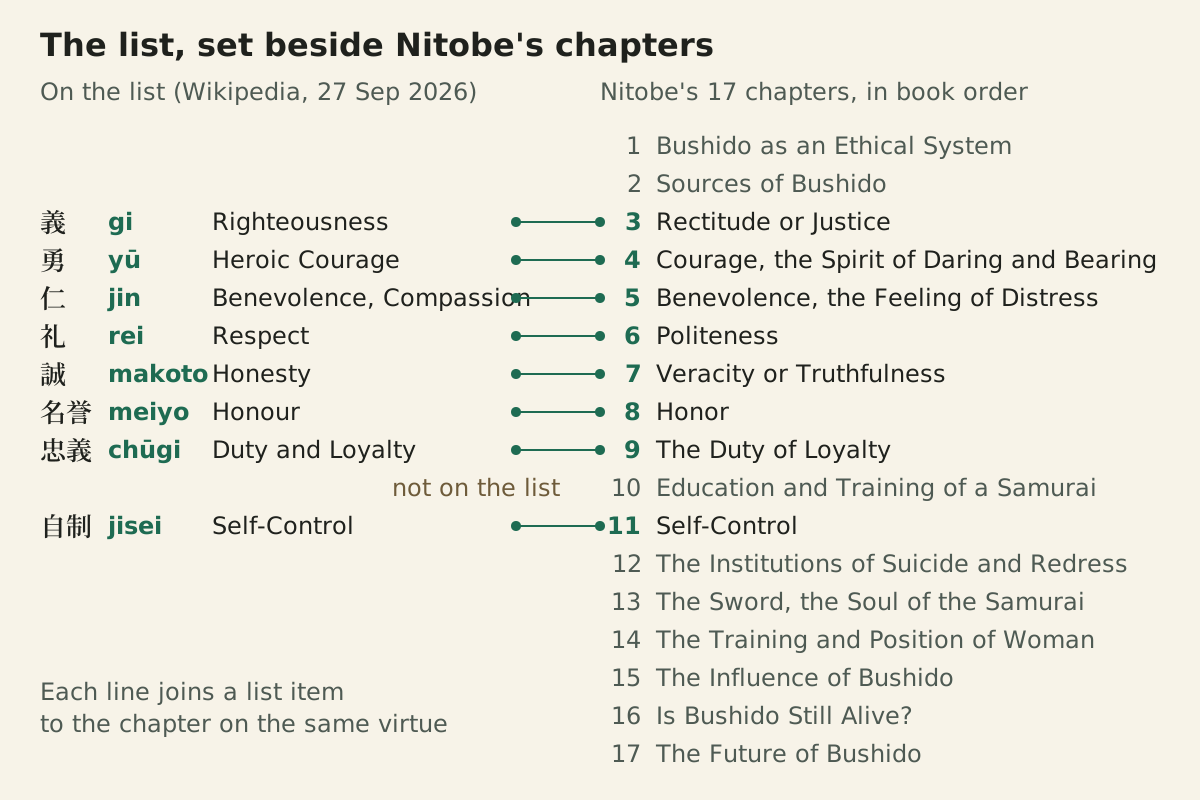
Set the seven virtues of bushido beside one book's table of contents, and they line up in order. The dated copy of the list used here is Wikipedia's "Bushido" article as revised on September 27, 2026. Its first seven virtues are gi (righteousness), yū (heroic courage), jin (benevolence, compassion), rei (respect), makoto (honesty), meiyo (honor) and chūgi (duty and loyalty), and an eighth, jisei (self-control), follows. Nitobe Inazō's Bushido: The Soul of Japan, written in English and first printed in Philadelphia in 1900, gives its third through ninth chapters to the first seven, in the same order, and its eleventh to self-control.
The match holds on the 1900 contents page and in the revised edition. That Wikipedia revision prints all eight under a heading that credits them to Nitobe. The list leaves out Nitobe's own wording. His chapter titles are in English, and two of the first seven Japanese words, meiyo and chūgi, appear nowhere in his revised text, by this page's count.
Who Nitobe wrote for
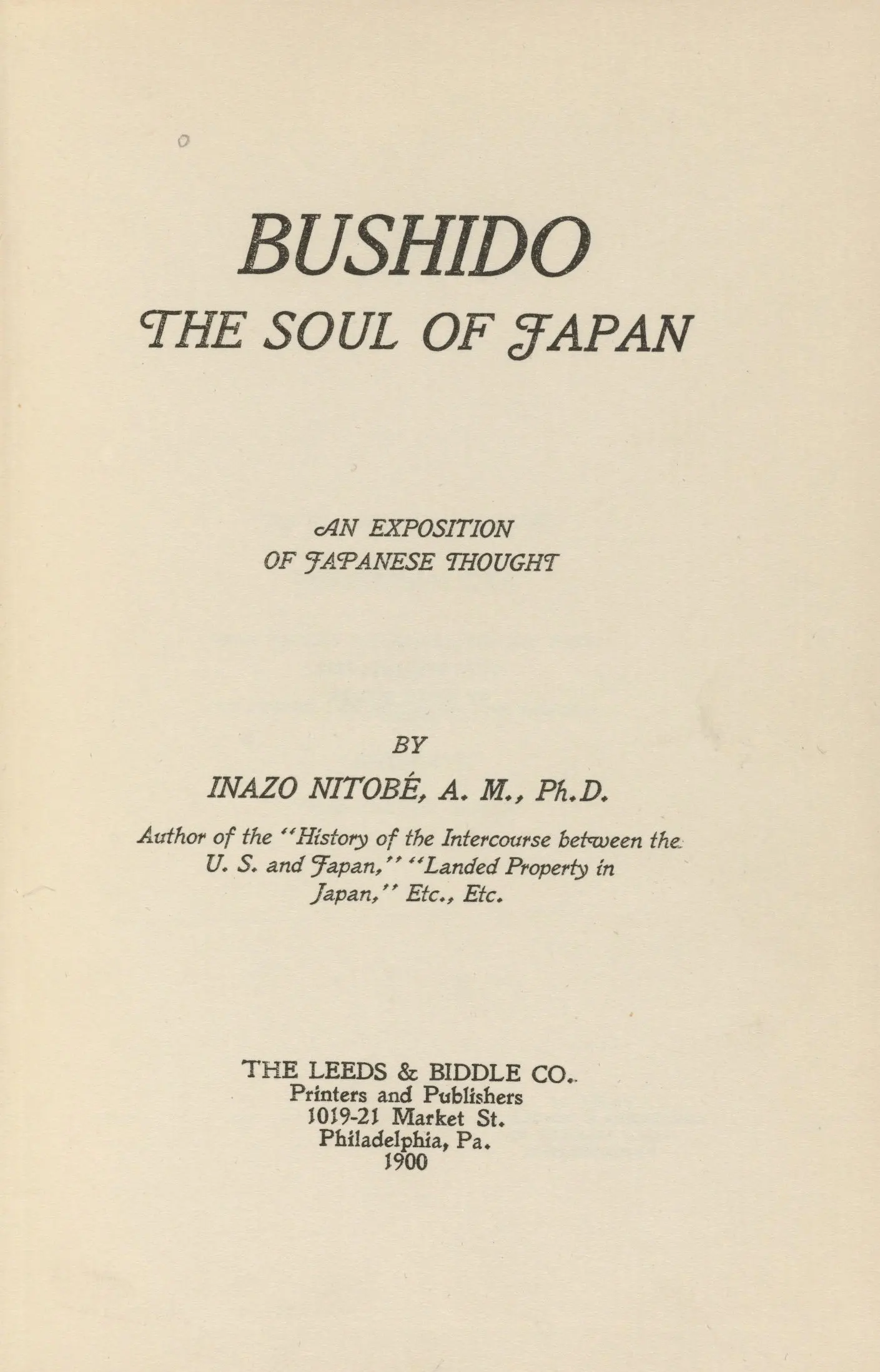

Nitobe Inazō (1862–1933) signed the first preface of Bushido: The Soul of Japan at Malvern, Pennsylvania, in the twelfth month of 1899. The title page of the first edition gives his degrees as A.M. and Ph.D. and lists him as the author of History of the Intercourse between the U. S. and Japan and Landed Property in Japan. This was not his first book on Japan.
The preface gives two reasons for writing it. About ten years earlier, the Belgian jurist M. de Laveleye had asked whether Japanese schools taught religion, and on hearing that they did not, asked how they gave any moral education. Nitobe's wife also kept asking why certain ideas and customs prevailed in Japan.
Nitobe wrote the answers while a long illness kept him idle, and they came out in a fixed sequence. He says so in the same preface: "I put down in the order now presented to the public some of the answers given in our household conversation." (Bushido, Preface, 1899) — verified. The chapter order is his own.
He meant the book for readers outside Japan. English was not his first language, and he knew it. He names Lafcadio Hearn, Mrs. Hugh Fraser, Sir Ernest Satow and Professor Chamberlain as writers whose work made writing about Japan in English a daunting task. Then he adds that "one who speaks in a borrowed tongue should be thankful if he can just make himself intelligible" (Bushido, Preface, 1899) — verified.
Seven chapters, seven virtues
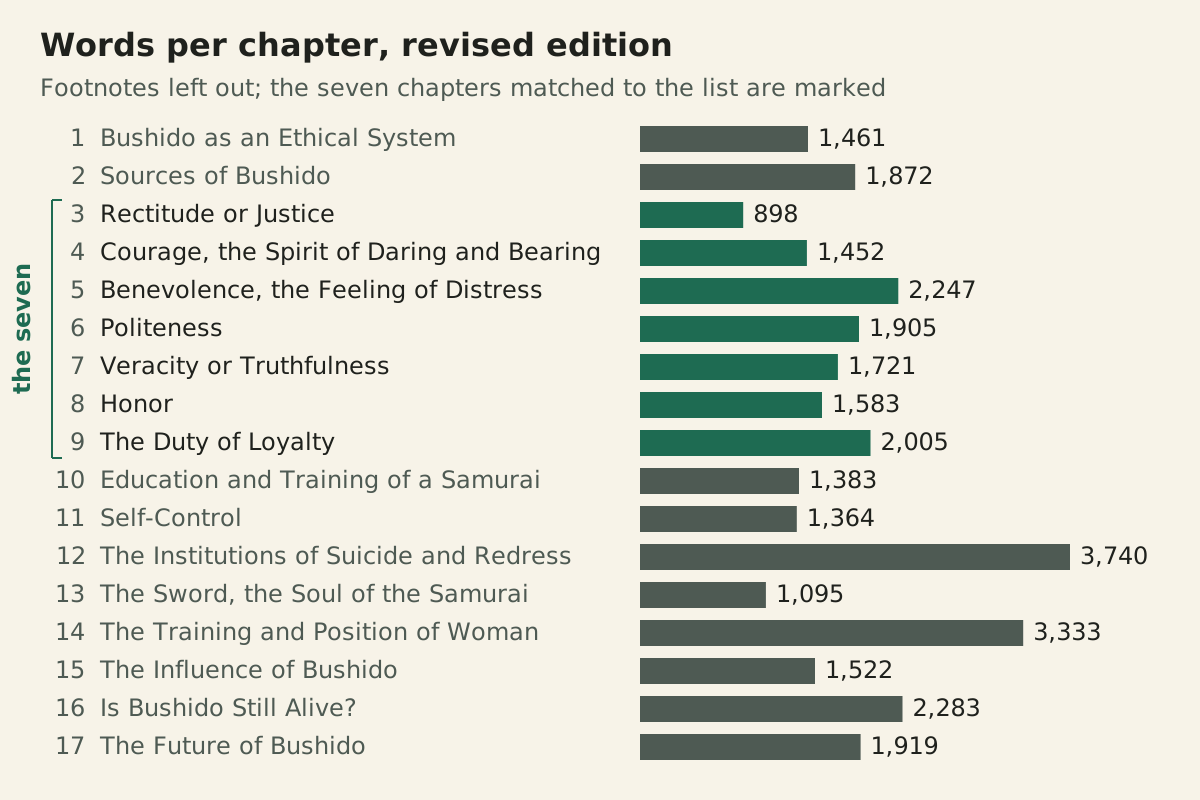
The contents page lists 17 chapter titles without numbers, so this page numbers them by position. Chapters 3 to 9 are "Rectitude or Justice," "Courage, the Spirit of Daring and Bearing," "Benevolence, the Feeling of Distress," "Politeness," "Veracity or Truthfulness," "Honor" and "The Duty of Loyalty." The 1900 contents page gives the same seven titles in the same order.
 Generated illustration
The two titles that changed between editions sit outside the run. The 1900 page has "Education and Training of Samurai" for chapter 10 and "Suicide and Revenge" in chapter 12, where the revised edition has "of a Samurai" and "Suicide and Redress."
In the revised edition, 15 of the 16 later headings, the seven among them, sit inside a sentence begun at the end of the chapter before: "I shall begin with RECTITUDE OR JUSTICE, the most cogent precept in the code of the samurai." (Bushido, chapters 2–3, revised edition) — verified. A list keeps the order but drops those joins.
By this page's count, the seven chapters hold 11,811 of the 17 chapters' 31,783 words, footnotes left out, or 37.2%. Benevolence gets the most room in the run and Rectitude the least. The two longest chapters lie outside it: chapter 12, on suicide and redress, and chapter 14, on the training and position of women. Every figure is in the chapter table (CSV, seven-virtues-bushido-chapters.csv).
The eight-item version adds self-control from chapter 11 and skips chapter 10, on education. One virtue Nitobe wanted to cover has no chapter at all. In the 1905 preface he regrets that he could not add a chapter on filial piety. Filial piety, he writes, is considered "one of the two wheels of the chariot of Japanese ethics," with loyalty as the other (Bushido, Preface to the Tenth and Revised Edition, 1905) — verified.
The Japanese words on the list
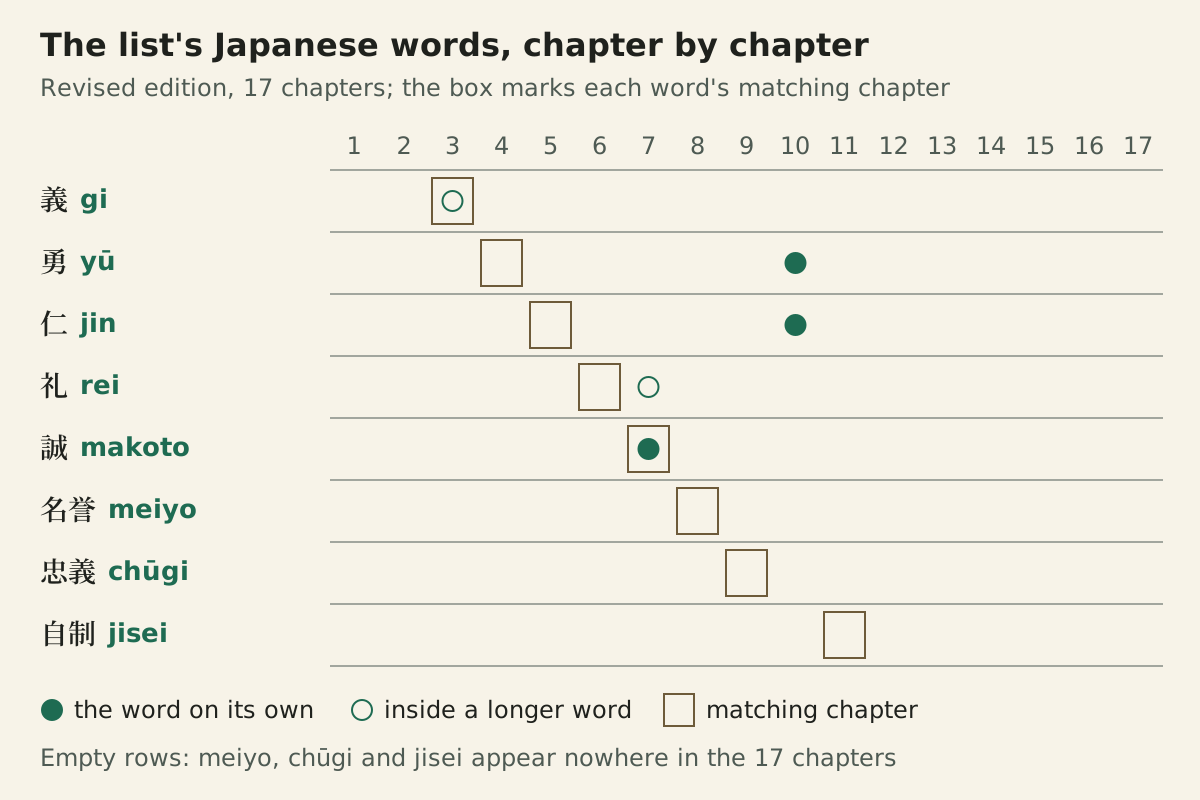
On the list, the first seven words come with kanji: 義 gi, 勇 yū, 仁 jin, 礼 rei, 誠 makoto, 名誉 meiyo and 忠義 chūgi. Nitobe's headings use English instead, and a search of his revised text for each romanized word turns up very little. Makoto appears once, in chapter 7, as the Japanese word for truth. Yū and jin appear once each, but in chapter 10, in a different set of three that he spells Chi, Jin, Yu: "The tripod that supported the framework of Bushido was said to be Chi, Jin, Yu, respectively Wisdom, Benevolence, and Courage." (Bushido, chapter 10, revised edition) — verified.
Gi shows up only inside longer words in chapter 3: Gishi, glossed as a man of rectitude, and Gi-ri, which Nitobe renders as the Right Reason. Rei shows up only inside kyo-rei, the empty form of politeness in chapter 7. Meiyo, chūgi and the eighth word, jisei, do not appear in the 17 chapters of Nitobe's revised edition at all. The honor chapter offers one clue: "Though the word ordinarily given now-a-days as the translation of Honor was not used freely," Nitobe writes, the idea was carried by na (name), men-moku (countenance) and guai-bun (outside hearing) (Bushido, chapter 8, revised edition) — verified.
The short explanation printed under each of the first seven virtues in that Wikipedia revision is not Nitobe's wording either. Not one five-word sequence from those seven explanations occurs anywhere in his 17 chapters, by this page's count. String matching only locates candidates, so the counts above keep just the hits that their own sentence confirms, the same rule this site applies to quotations under the five verdicts. A similar gap between a modern list and its source text is measured for yoga in what the Yoga Sutras say about postures.
Who Nitobe names
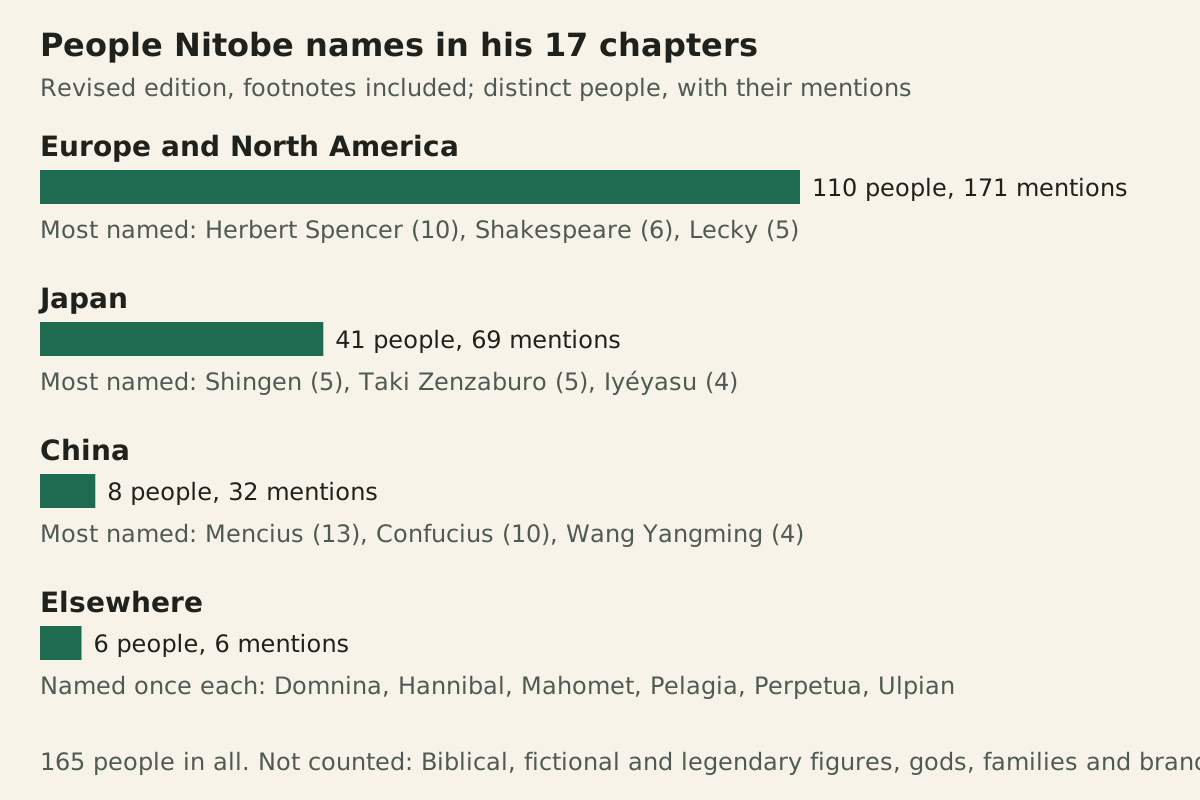
The preface promises a method: "I have tried to illustrate whatever points I have made with parallel examples from European history and literature" (Bushido, Preface, 1899) — verified. The names in the chapters show how far he went. By this page's count, the 17 chapters name 165 real people: 110 from Europe and North America, 41 from Japan, 8 from China and 6 from elsewhere.
Counted by mentions, Europe and North America lead with 171, against 69 for Japan and 32 for China. Mencius is named most, with 13 mentions. Confucius and Herbert Spencer follow, with 10 each. Shakespeare appears 6 times, more than any Japanese figure; the most-named Japanese, Shingen and Taki Zenzaburo, appear 5 times each.
The counting rules decide the edge cases, so they are spelled out. Biblical figures, characters from fiction and legend, gods, families, schools and brands are left out. So are three names whose person this page could not pin down. Every counted name, with its group and the chapters it appears in, is in the list of names (CSV, seven-virtues-bushido-names.csv).
Was bushido a written code?
Samurai had no written code of conduct called bushido, on Nitobe's own account. His first chapter puts it plainly:
"It is not a written code; at best it consists of a few maxims handed down from mouth to mouth or coming from the pen of some well-known warrior or savant."
Nitobe, Bushido, chapter 1, revised edition — verified
 Generated illustration
He does mention the Military Statutes (Buké Hatto) issued early in the seventeenth century, but says their "thirteen short articles" dealt mostly with marriages, castles and leagues (Bushido, chapter 1, revised edition) — verified. That is Nitobe's description, and this page has not compared it with the statutes themselves. By the 1905 preface, he reports, the Japanese reprint had run through eight editions, and translations into Marathi, German, Bohemian and Polish had appeared.

In 1912, B. H. Chamberlain went further in a pamphlet, The Invention of a New Religion: "Bushido, as an institution or a code of rules, has never existed." (Chamberlain, 1912) — verified. The pamphlet's text does not mention Nitobe by name.
Chamberlain also offers a test that this page has not run: "THE VERY WORD APPEARS IN NO DICTIONARY, NATIVE OR FOREIGN, BEFORE THE YEAR 1900." (Chamberlain, 1912) — verified. A claim like that needs dated dictionaries to confirm or refute. None is cited here.
What the match does not settle

This site's reading, which you are free to dispute, is that most of what circulates as bushido today is a discourse built in the Meiji era rather than a self-portrait of Edo-period samurai. The scholarship to test that against is Oleg Benesch's Inventing the Way of the Samurai (Oxford University Press, 2014). Only its bibliographic record was available for this entry, and that record's chapter titles include "First Explanations of Bushidō in the Meiji Era" (pp. 42–75) and "The Early Bushidō Boom, 1894–1905" (pp. 76–110). None of this makes Edo-period ethics an invention; the narrower finding is that this one list matches the order of one English book.
When the virtues were first set out as a numbered list remains open here, because tracing that step needs dated appearances this entry does not have. The same kind of check, one book's account set against dated sources, is run on Zen in the Art of Archery. Your next step is to run it on a single virtue, with the book open.
Practice
Off the page:
A reading drill for one sitting, done with Nitobe's text in front of you:
- Pick one virtue from the list and find its chapter in the virtue-to-chapter table (CSV, seven-virtues-bushido-virtues-chapters.csv).
- Open that chapter in the Project Gutenberg text of the revised edition.
- Write down the one-line definition that your copy of the list gives for the virtue.
- Copy the first sentence in which Nitobe says what the virtue is, with the chapter title.
- Note one Japanese word Nitobe uses in that chapter, then set it beside the word on the list.
- Write one line on what the list kept, dropped or added.
For the same check run on single quotations, try the Stoic Quote Ledger. For another book behind a martial-arts story, read Zen in the Art of Archery.
Sources
- [1] Inazo Nitobe, Bushido: The Soul of Japan, Author's Edition, Revised and Enlarged, 13th edition (Tokyo, 1908), with the 1899 preface and the preface to the tenth and revised edition (Kyoto, 1905); Project Gutenberg eBook #12096. www.gutenberg.org/ebooks/12096 Consulted: full text: both prefaces, contents and all 17 chapters
- [2] Inazo Nitobé, Bushido: The Soul of Japan, An Exposition of Japanese Thought (Philadelphia: The Leeds & Biddle Co., 1900), first edition. archive.org/details/bushidosouljapa00nitogoog Consulted: title page, first preface signature and contents page
- [3] Basil Hall Chamberlain, The Invention of a New Religion (1912); Project Gutenberg eBook #2510. www.gutenberg.org/ebooks/2510 Consulted: full text
- [4] Wikipedia contributors, "Bushido," Wikipedia, revision 1377093914 (last edited September 27, 2026). en.wikipedia.org/w/index.php?title=Bushido&oldid=1377093914 Consulted: the section listing eight virtues and the section mentioning seven virtues; list structure only
- [5] Oleg Benesch, Inventing the Way of the Samurai: Nationalism, Internationalism, and Bushidō in Modern Japan (Oxford University Press, 2014), doi:10.1093/acprof:oso/9780198706625.001.0001. doi.org/10.1093/acprof:oso/9780198706625.001.0001 Consulted: bibliographic record only: title, publisher, date, chapter titles and page ranges
- [6] Aozora Bunko, author page No. 718, Nitobe Inazō. www.aozora.gr.jp/index_pages/person718.html Consulted: birth and death dates (1862-09-01, 1933-10-16)
- [7] Digesta, edited by Theodor Mommsen, in Corpus iuris civilis, vol. 1, fifth stereotype edition (Berlin: Weidmann, 1889). archive.org/details/corpusjuriscivil01krueuoft Consulted: Digest 50.15.1 pr. (p. 856), where Ulpian names the Tyrian colony in Syria Phoenice as the place of his origin
Cite this page
Virtue & Paradox. “Seven Virtues of Bushido: Same Order as Nitobe's Chapters.” Published 2026-10-17; last substantive revision 2026-10-17. https://virtueandparadox.com/martial-philosophy/seven-virtues-bushido/. Accessed (the date you read it).