Yoga PhilosophyClose reading of a source text
Yoga Sutras on Postures: Three Sutras, and No Pose Named
Source card
Texts this entry reads, by coordinate and edition.
- Yoga Sutra 2.29James Haughton Woods translation (1914), p. 177Source [1] · open the text
- Yoga Sutras 2.46–2.48James Haughton Woods translation (1914), pp. 191–192Source [1] · open the text
- Vyāsa's comment and Vācaspati Miśra's explanation on Yoga Sutras 2.46–2.48James Haughton Woods translation (1914), pp. 191–192the list of twelve names, p. 191Source [1] · open the text
- Yoga Sutra 2.55James Haughton Woods translation (1914), p. 198Source [1] · open the text
- Yoga Sutras 2.29, 2.46–2.48Charles Johnston translation (1912), pp. 49–50 for 2.46–2.48Source [2] · open the text
Show 2 more, VI–VIIHide VI–VII
- Yoga Sutras 2.29, 2.46–2.48, 2.54Swami Vivekananda translation, Raja Yoga (1920 printing), pp. 179, 184–185, 187Source [3] · open the text
- Sections 1 and 4Edwin Bryant, Internet Encyclopedia of Philosophy entry, accessed 2026-10-17dating and the count of posture sutrasSource [4] · open the text
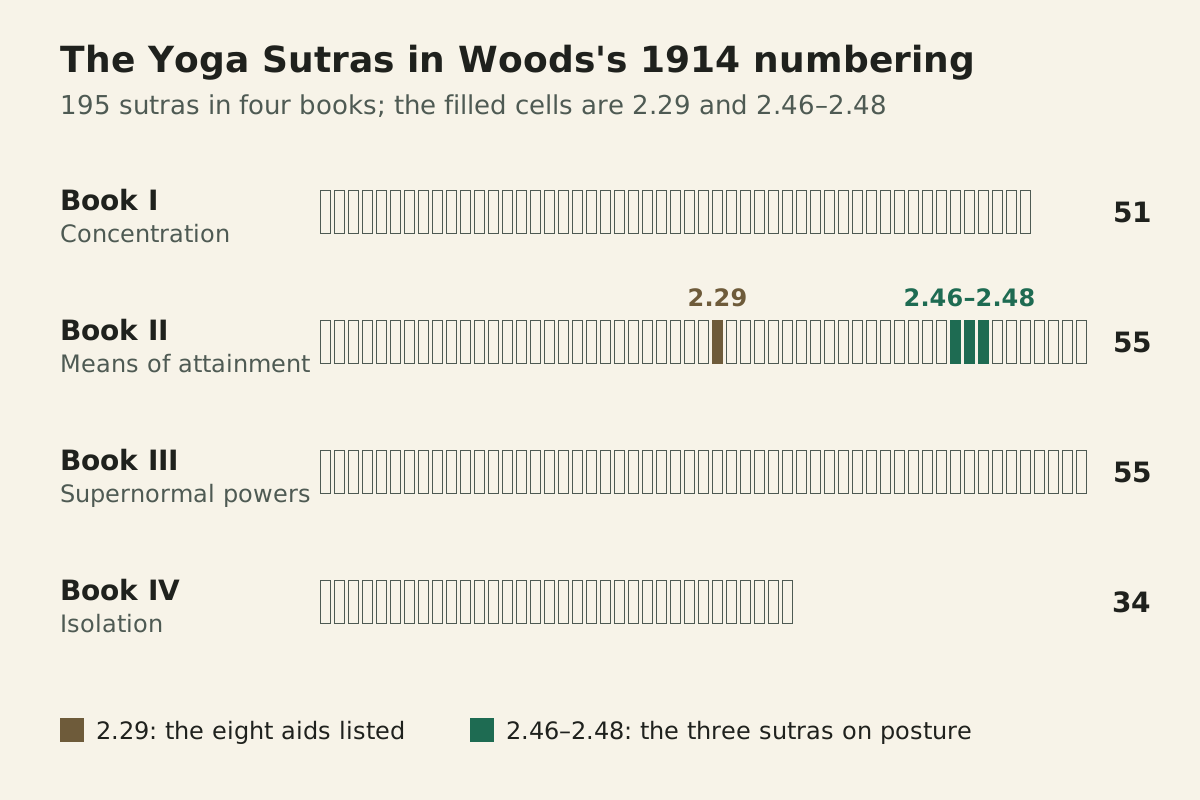
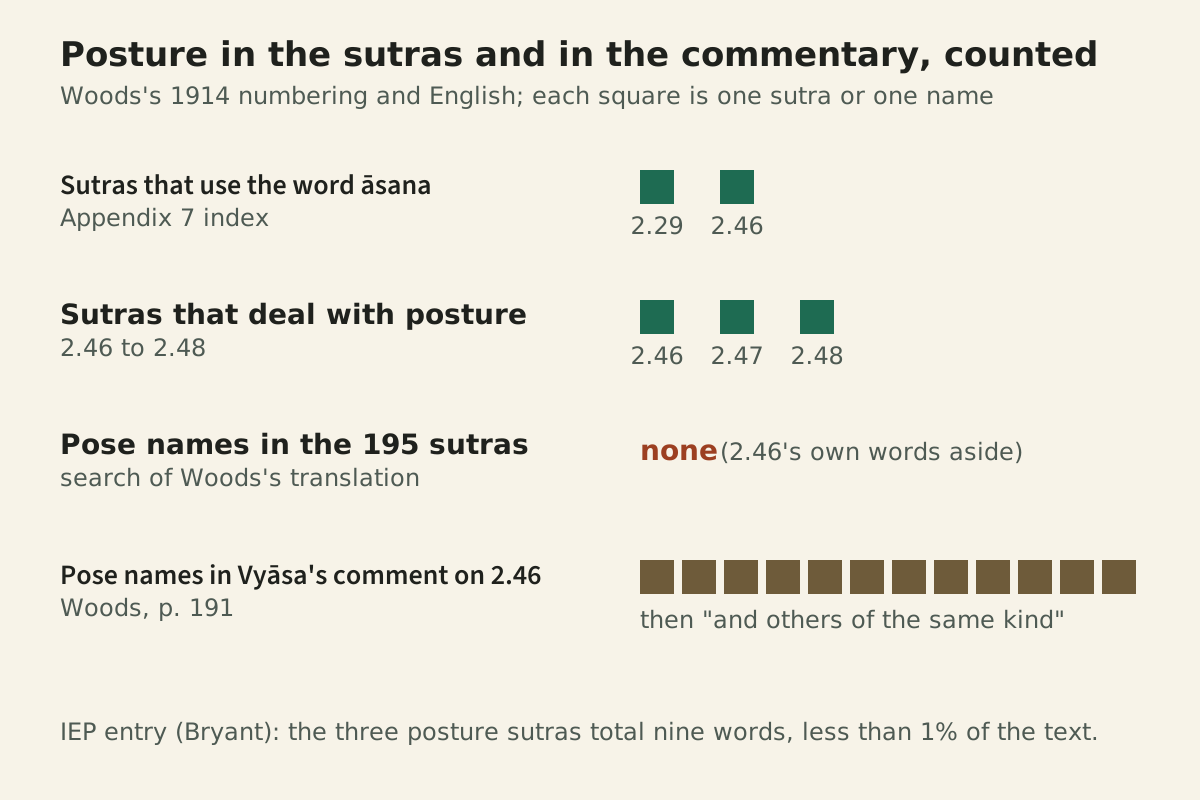
Search the Yoga Sutras in three public-domain translations for a pose name and you come back empty-handed. In James Haughton Woods's 1914 translation the Yoga Sutras run to 195 sutras, short numbered statements, in four books. Only three of them, 2.46 to 2.48, deal with āsana, the seat or posture, and a fourth, 2.29, lists āsana third among eight aids to yoga. None of the four names a pose; the names appear in the commentary attributed to Vyāsa, which lists twelve and then adds "others of the same kind."
Where does posture appear in the Yoga Sutras?
In the Sanskrit text Woods translated, the word āsana turns up in two sutras. His Appendix 7, an index "designed to include all the words of the text of the Sūtras, and no others," lists it at 2.29 and 2.46 only. Sutras 2.47 and 2.48 carry the topic on without repeating the word. Then 2.49 moves to the breath.
.png)
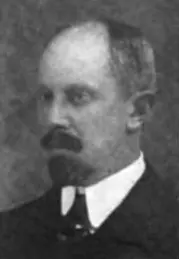
Yoga Sutra 2.29 lists eight aids, in this order: yama, niyama, āsana, prāṇāyāma, pratyāhāra, dhāraṇā, dhyāna and samādhi. Woods renders the whole sutra this way:
"Abstentions and observances and postures and regulations-of-the-breath and withdrawal-of-the-senses and fixed attention and contemplation and concentration are the eight aids."
Yoga Sutra 2.29 (Woods 1914 translation, page 177) — verified
The Sanskrit word for the eight, aṅgāni, is "aids" in Woods and "limbs" in Swami Vivekananda's version, which leaves all eight terms in Sanskrit and writes "Âsana" for the third. Charles Johnston's 1912 version calls the third item "right Poise." In all three, posture comes third, after the abstentions and observances and before the breath.
The sutras that follow 2.29 take the aids one at a time, and they show how much room each one gets. From 2.30, where the abstentions begin, to 3.3, where concentration is defined, Woods's numbering runs 29 sutras. By this page's count, the abstentions and observances take sixteen (2.30–2.45), the breath five, withdrawal of the senses two and the last three aids one each; postures get three.
Sutra 2.46, word by word
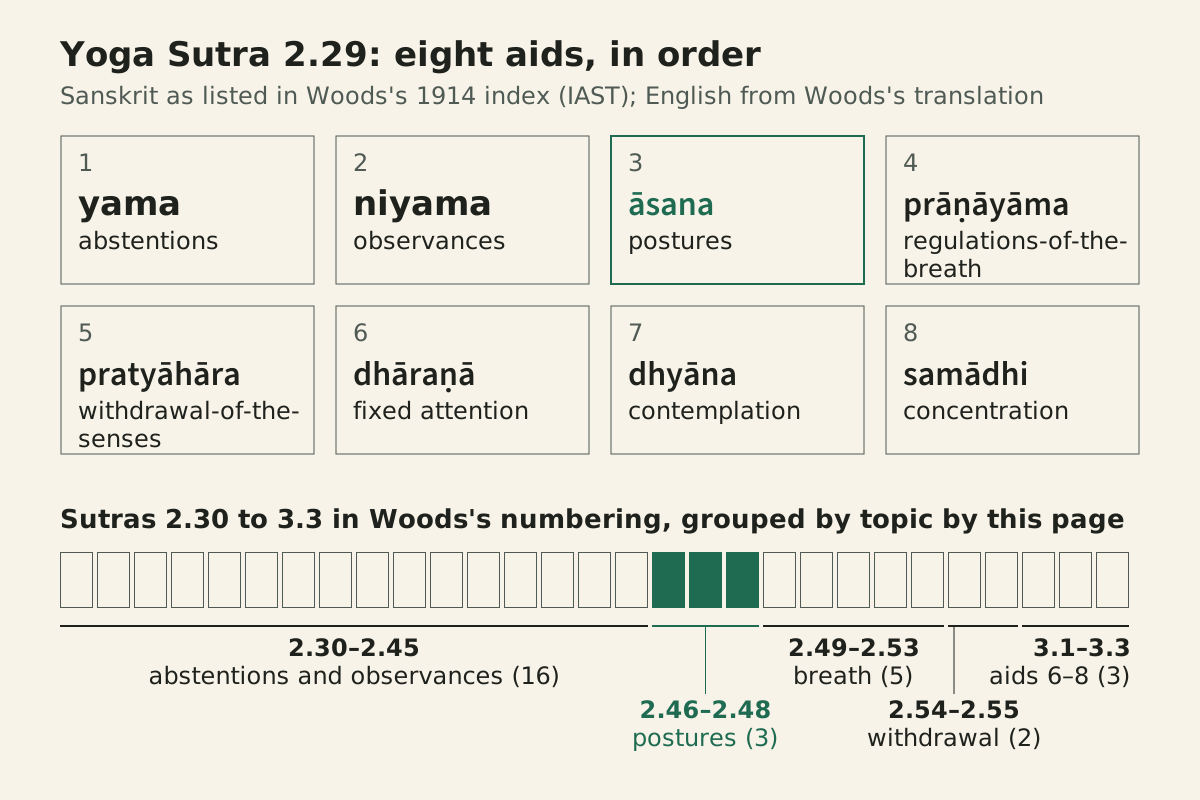
Sutra 2.46 is three words in Woods's index: "sthira-sukham āsanam." Vācaspati Miśra, a ninth-century commentator whose explanation Woods translates in the same volume, glosses the first word: "Stable means motionless." The last word, he writes, means "either that whereon a man sits [that is, a seat] or the manner in which he sits [that is, a posture]" (Vācaspati Miśra on Yoga Sutra 2.46, Woods 1914 translation, page 191) — verified. The three public-domain translations read as follows.
| Translation | Yoga Sutra 2.46 |
|---|---|
| Woods 1914, p. 191 | "Stable-and-easy posture." — verified |
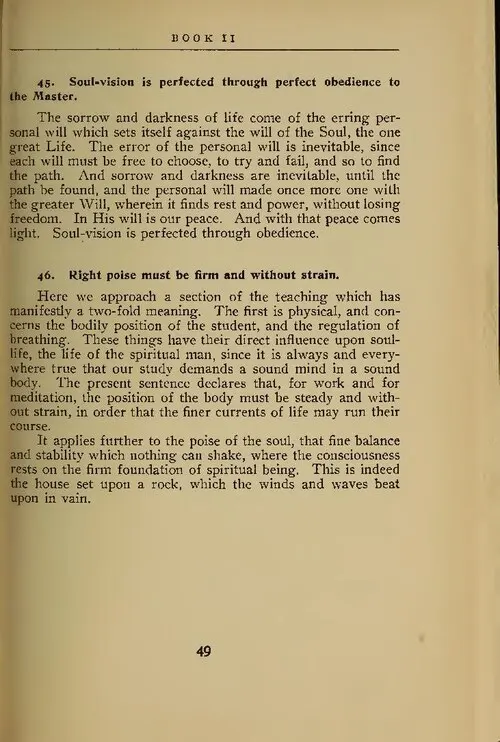
| Johnston 1912, p. 49 | "Right poise must be firm and without strain." — verified |
| Vivekananda, 1920 printing, p. 184 | "Posture is that which is firm and pleasant." — verified |
All three keep the sutra's two qualities: stable or firm, and easy, pleasant or without strain. None adds a body part, a shape, a number or a length of time.
Johnston reads the line as having "a two-fold meaning," one about "the bodily position of the student" and one about "the poise of the soul." That double reading is his own commentary, printed under the sutra on the page shown below.
2.47 and 2.48: how posture is reached, and what follows
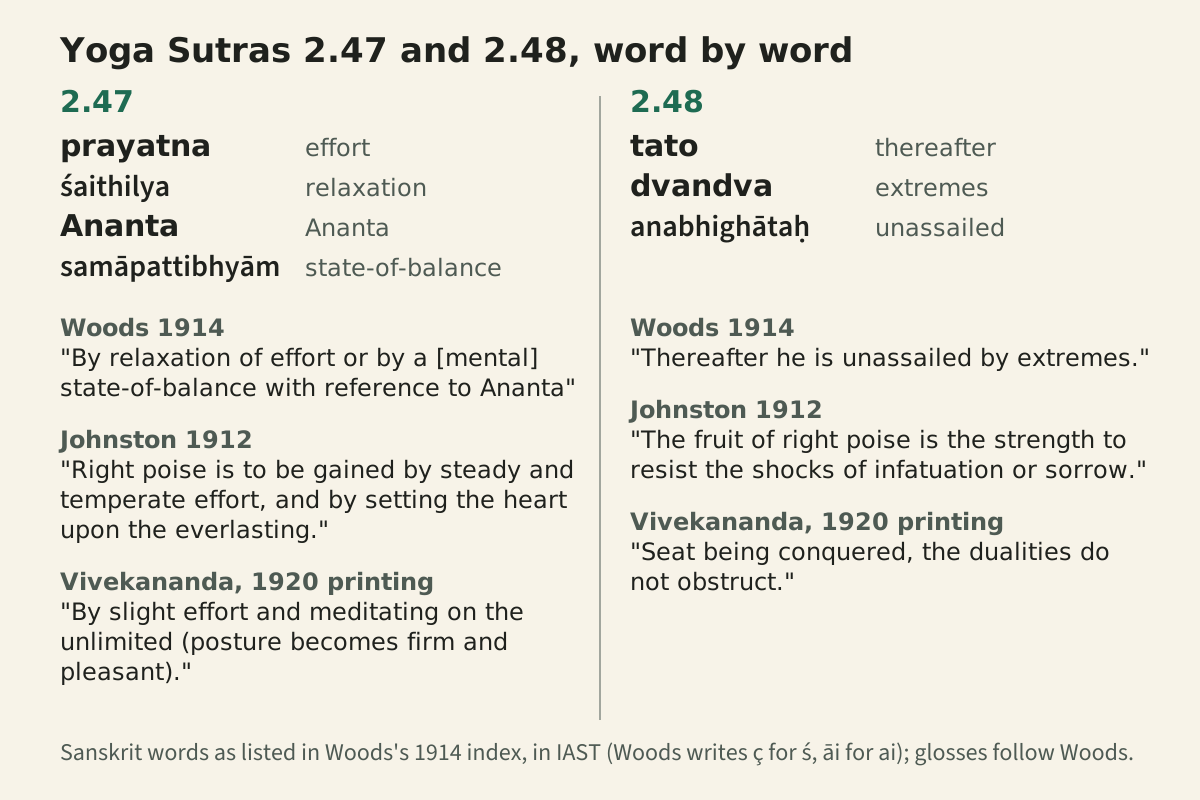
Sutra 2.47 says how the posture comes about. Here the translators part ways. Woods's index prints its words as prayatna-çāithilya and Ananta-samāpattibhyām; in IAST, the standard scheme used on this site, the first is prayatna-śaithilya. The table sets the three renderings of 2.47 and 2.48 side by side.
| Translation | 2.47 | 2.48 |
|---|---|---|
| Woods 1914, p. 192 | "By relaxation of effort or by a [mental] state-of-balance with reference to Ananta" — verified | "Thereafter he is unassailed by extremes." — verified |
| Johnston 1912, p. 50 | "Right poise is to be gained by steady and temperate effort, and by setting the heart upon the everlasting." — verified | "The fruit of right poise is the strength to resist the shocks of infatuation or sorrow." — verified |
| Vivekananda, 1920 printing, p. 185 | "By slight effort and meditating on the unlimited (posture becomes firm and pleasant)." — verified | "Seat being conquered, the dualities do not obstruct." — verified |
The three disagree on effort: Woods has effort relaxed, Johnston "steady and temperate effort," Vivekananda "slight effort." This page does not choose between them. On the second half, Woods keeps the name Ananta, whom Vācaspati Miśra calls "the Chief of Serpents," while Johnston writes "the everlasting" and Vivekananda "the unlimited."
Sutra 2.48 is a claim about what follows. In Woods's index its words are tato, dvandva and anabhighātaḥ, which his English renders as "thereafter," "extremes" and "unassailed." The comment he translates explains that the practitioner "is not overcome by the extremes, by cold and heat and by the other [extremes]" (Vyāsa on Yoga Sutra 2.48, Woods 1914 translation, page 192) — verified. That is the text's claim about mastery, read here as text and not as a tested effect, and this page gives no instruction for taking or holding any posture.
 Generated illustration
The next sutra, 2.49, turns to restraint of the breath. This page treats that topic only as text, too.
What does the oldest surviving commentary add?
The commentary attributed to Vyāsa is "the first extant commentary," according to Edwin Bryant's entry on the Yoga Sutras in the Internet Encyclopedia of Philosophy (IEP). On 2.46 it offers a list:
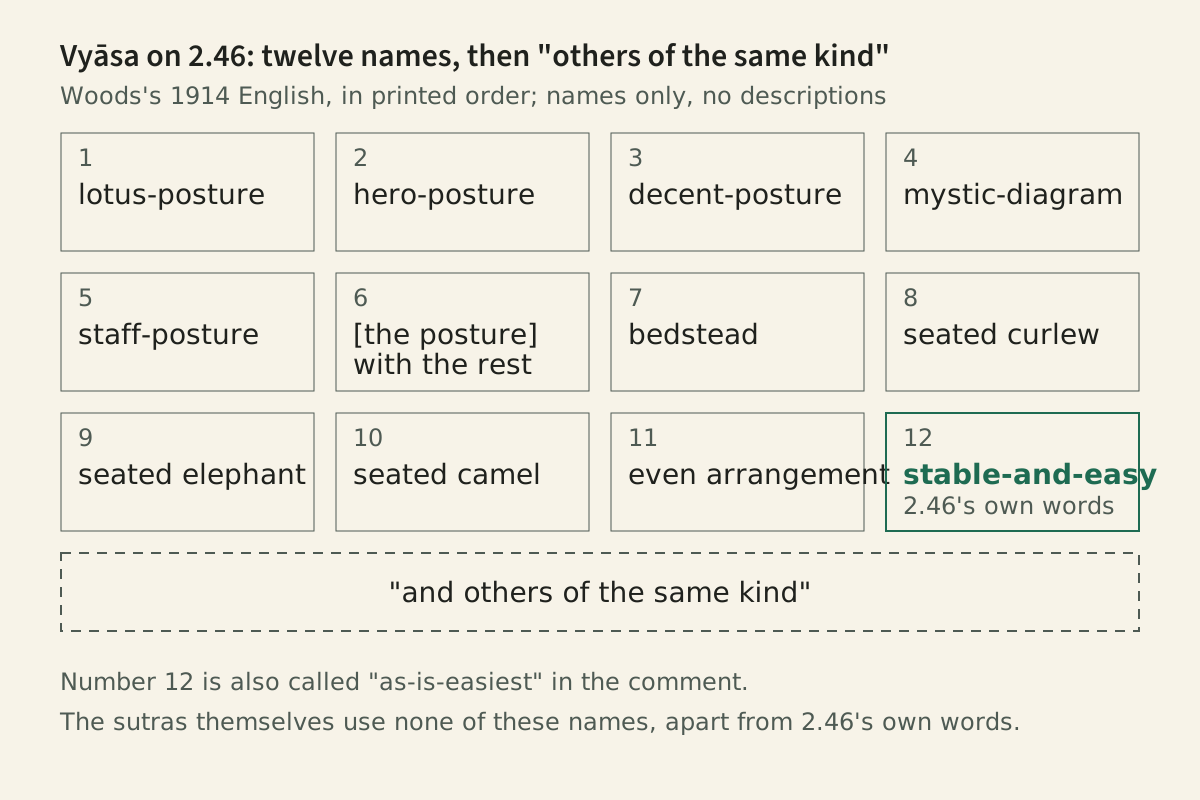
"For example, the lotus-posture and the hero-posture and the decent-posture and the mystic-diagram and the staff-posture and [the posture] with the rest and the bedstead, the seated curlew and the seated elephant and the seated camel, the even arrangement, the stable-and-easy—also called, as-is-easiest—and others of the same kind."
Vyāsa on Yoga Sutra 2.46 (Woods 1914 translation, page 191) — verified
That makes twelve names before the closing phrase, and Bryant's entry also counts twelve "followed by 'etc.'," which he reads as a sign of "a well known tradition of variants." Some names come from animals (curlew, elephant, camel) and some from objects (staff, bedstead). The twelfth, stable-and-easy, repeats the sutra's own two words. Vācaspati Miśra calls it "the one from among these [postures] which is approved by the Exalted Author of the sūtras" (Vācaspati Miśra on Yoga Sutra 2.46, Woods 1914 translation, page 192) — verified.
Vācaspati goes on to describe how several of the others are formed. This page lists the names only and gives no instructions for any of them.
195 or 196?
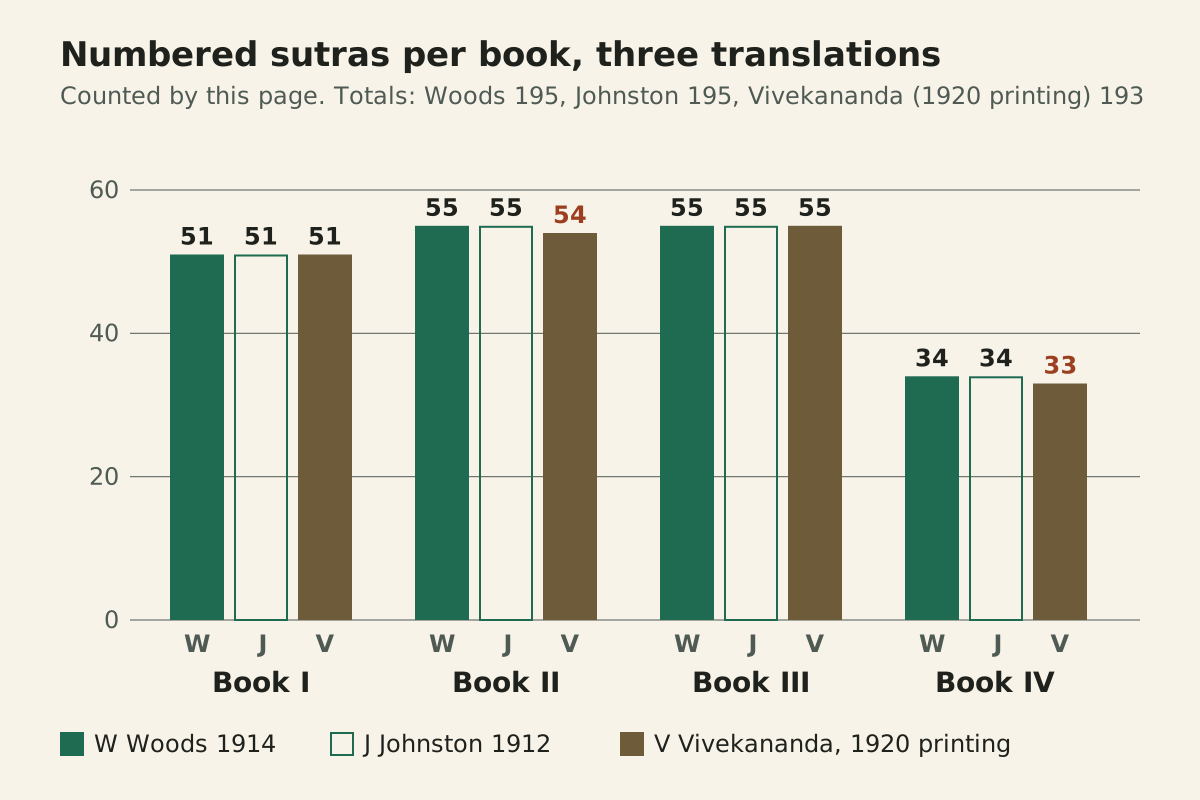
In Woods's 1914 translation, which this page follows for every sutra number, the Yoga Sutras have 195 sutras: 51, 55, 55 and 34 in the four books. Charles Johnston's 1912 translation numbers the same 195. Swami Vivekananda's Raja Yoga, in the Brentano's printing of 1920, numbers 193. None of the three reaches 196.
| Edition | Book I | Book II | Book III | Book IV | Total |
|---|---|---|---|---|---|
| Woods 1914 | 51 | 55 | 55 | 34 | 195 |
| Johnston 1912 | 51 | 55 | 55 | 34 | 195 |
| Vivekananda, 1920 printing | 51 | 54 | 55 | 33 | 193 |
The Vivekananda printing has two fewer numbers than Woods, for two different reasons. Woods's 2.55 reads "As a result of this [withdrawal] there is complete mastery of the organs" (Yoga Sutra 2.55, Woods 1914 translation, page 198) — verified; in Vivekananda the same point is an unnumbered sentence inside the comment on 2.54, "Thence arises supreme control of the organs" (Vivekananda, 1920 printing, page 187) — verified. Book IV has no aphorism matching Woods's 4.16, so Woods's 4.17 is Vivekananda's 4.16. All three number the posture sutras 2.46, 2.47 and 2.48.
Woods worked from the Calcutta edition of Bālarāma, chosen, he writes, "because it is based on northern manuscripts." A program listed every numbered sutra in each of the three texts and checked that each book runs from 1 with no gaps; where a printed number was unclear, the count was checked against the page scan. Bryant's IEP entry also gives "195 sūtras." How this site checks verse numbers explains why every count names its edition, and the counts by book are in a table of sutra counts for the three editions (CSV) (CSV, yoga-sutras-postures-numbering.csv).
How far is modern posture practice from these three sutras?
Measured by the text alone, the distance is wide. Posture takes 3 of Woods's 195 sutras, or 1.54% by this page's count, and Bryant's IEP entry counts "a total of nine words" in those three, "less than 1% of the text." A search of all 195 sutras in Woods's translation finds none of Vyāsa's twelve names apart from 2.46's own "stable-and-easy." The only other match is "powers like those of an elephant" in 3.24, which is not a seat.
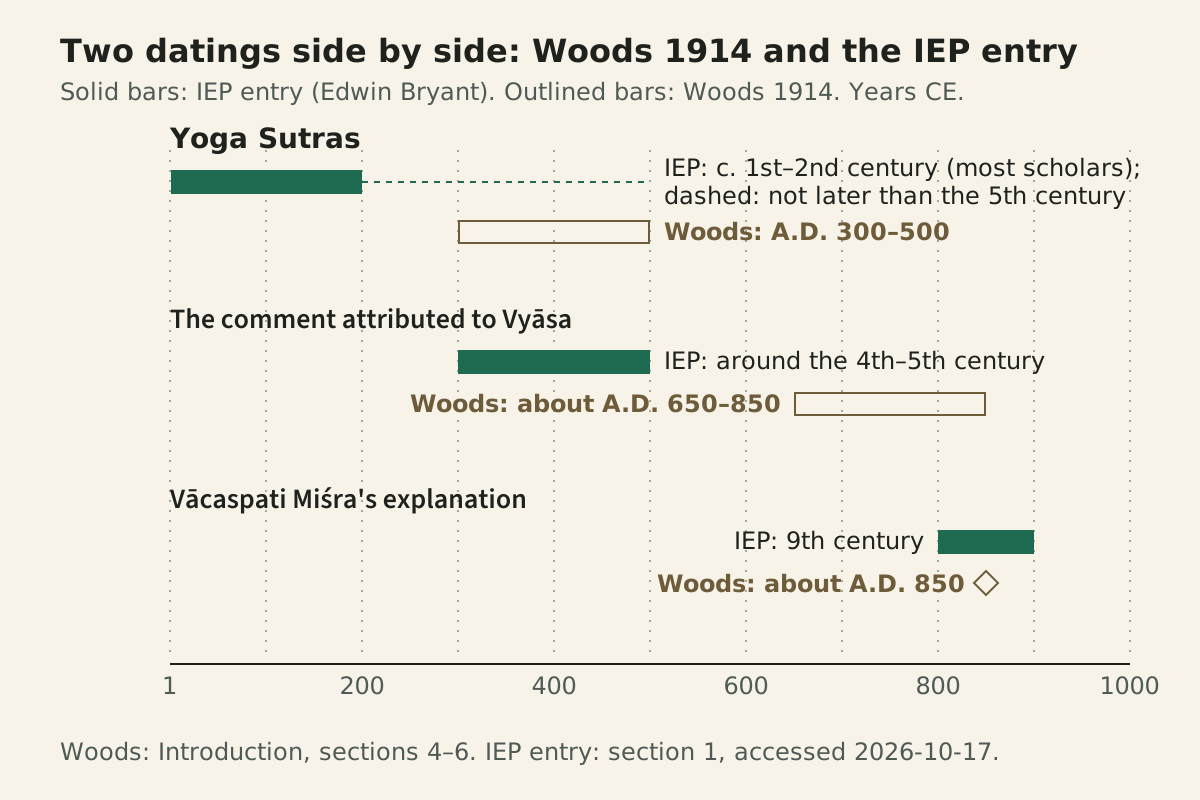
The dates point the same way. Woods, writing in 1914, placed the sutras between A.D. 300 and 500 and the commentary between about A.D. 650 and 850. Bryant writes that most scholars "seem to date the text" to about the first or second century C.E., that some place it centuries earlier, and that the commentary is "typically dated to around the 4–5th century C.E." The two sources disagree on the dates, and this page shows both; on either dating, the commentary with its list is later than the sutras.
Bryant goes further. He calls the presentation of yoga as mainly bodily poses "essentially a modern Western phenomenon" that "finds no precedent in the premodern Yoga tradition." That is his conclusion in the IEP entry; this page has checked the texts and dates above, not the history of modern practice.
Those counts and dates are the evidence behind this site's reading, which you are free to reject: modern posture yoga has a much thinner link to the Yoga Sutras than the yoga industry claims. The same question, how far a modern practice sits from the text it cites, runs through Zen in the Art of Archery. Bryant also notes that the Upanishads his entry places in the late Vedic age and the Bhagavad Gita use āsana for a seat, not for bodily poses. The Gita gets the same word-by-word reading in Bhagavad Gita 2.47.
Your next step needs two translations and a pencil: set Woods's 2.46 beside Johnston's and mark every word that one has and the other lacks.
Practice
Off the page:
A reading drill for the next 24 hours, done at a desk. Treat it as one rep of close reading; it involves no movement.
- Copy Yoga Sutra 2.46 twice, once as Woods gives it ("Stable-and-easy posture.") and once as Johnston gives it ("Right poise must be firm and without strain.").
- Underline every word in either version that names a body part, a shape, a number or a length of time, and write down the count for each.
- Write one line on what Johnston's "must" adds to Woods's wording.
- Read Vyāsa's list in the quotation above and mark the one name that repeats the sutra's own words.
- Run the same two-translation comparison on Bhagavad Gita 2.47, or on the Epictetus passage behind the dichotomy of control, the split between what is up to you and what is not.
Sources
- [1] James Haughton Woods (trans.), The Yoga-System of Patañjali; or, The Ancient Hindu Doctrine of Concentration of Mind, with the comment attributed to Veda-vyāsa and the explanation of Vācaspati-miśra, Harvard Oriental Series 17 (Cambridge, MA: Harvard University Press, 1914). archive.org/details/yogasystemofpata00wooduoft Consulted: Preface p. xi; Introduction pp. xvii–xxi; Analytical Summary pp. xxvi–xxvii; the sutras translated without the comment, pp. xxx–xli; Book II pp. 177, 191–193 and 198; Appendix 7, index of words in the sutras, pp. 366–380
- [2] Charles Johnston, The Yoga Sutras of Patanjali: "The Book of the Spiritual Man"; An Interpretation (New York: Charles Johnston, 1912); Project Gutenberg eBook #2526. www.gutenberg.org/ebooks/2526 Consulted: full text; pp. 49–50 of the 1912 printing (sutras 2.45–2.48) and its title and copyright pages compared
- [3] Swami Vivekananda, Raja Yoga, being lectures by the Swami Vivekananda with Patanjali's aphorisms, commentaries and a glossary of terms, new edition with enlarged glossary (New York: Brentano's, 1920). archive.org/details/raajayogabeingle00viveuoft Consulted: Patanjali's aphorisms with Vivekananda's comments, pp. 104–223, with pp. 144–145, 179, 184–185, 187 and 223 and the title and copyright pages compared on the printed page
- [4] Edwin Bryant, "The Yoga Sutras of Patanjali," Internet Encyclopedia of Philosophy, ISSN 2161-0002. iep.utm.edu/yoga/ Consulted: section 1, Background and Author, and section 4, Soteriology and Praxis
Cite this page
Virtue & Paradox. “Yoga Sutras on Postures: Three Sutras, and No Pose Named.” Published 2026-10-17; last substantive revision 2026-10-17. https://virtueandparadox.com/yoga-philosophy/yoga-sutras-postures/. Accessed (the date you read it).