StoicismDrill guide
Stoic Evening Routine: Seneca Credits the Habit to Sextius
Source card
Texts this entry reads, by coordinate and edition.
- De Ira 3.36.1–4Aubrey Stewart translation (1889)Book 5, chapter 36 in Stewart's numbering of the dialogues; printed pages 154–155Source [1] · open the text
- De Ira 3.36.1–4Latin text and translation, J. W. Basore (Loeb, 1928)section numbers used on this pageSource [2] · open the text
- Discourses 3.10.1–4 and 4.6.31–35George Long translation (1877)Source [3] · open the text
- Discourses 3.10 and 4.6Greek text ed. Heinrich Schenkl (1916)section numbersSource [4] · open the text · Text licence: CC BY-SA 4.0
- Letters to Lucilius 64.2R. M. Gummere translation (1917)Source [5] · open the text
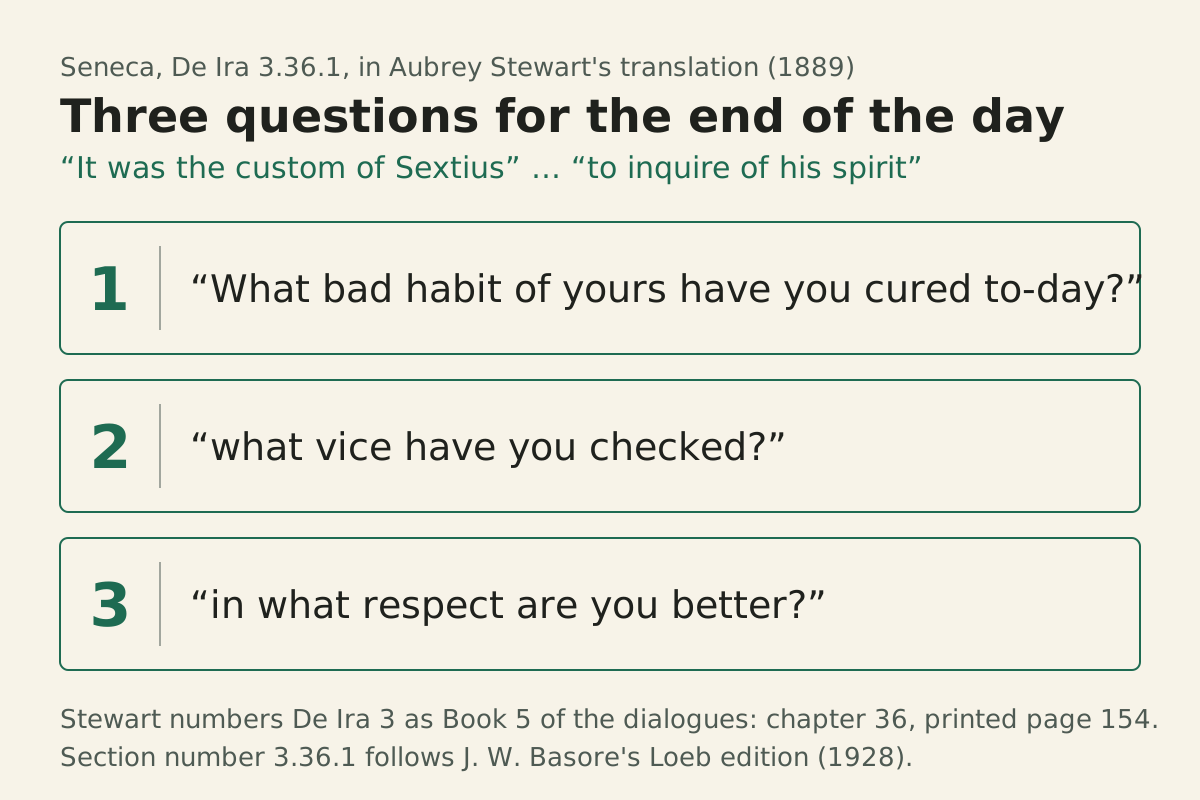
The lamp is taken out, his wife stops talking, and Seneca goes back over his whole day. That scene comes from De Ira 3.36, where Seneca describes a Stoic evening routine and credits it to another man: "It was the custom of Sextius," he writes, to question himself once the day was over (De Ira 3.36.1, Stewart translation — verified). The routine in De Ira 3.36 has three parts: go over everything you said and did, ask Sextius's three questions, and close with a pardon and instructions for next time.
Each quotation from an ancient text here carries a coordinate and one of the five verdicts set out in How Claims Are Tested. Section numbers follow J. W. Basore's 1928 Loeb edition of De Ira.
What did Seneca do each night?
Aubrey Stewart's 1889 translation numbers Seneca's dialogues as books, so De Ira 3.36 is his Book 5, chapter 36. Stewart's translation is also one of the texts searched in the Stoic Quote Ledger. Early in the chapter Seneca sets a rule: "The spirit ought to be brought up for examination daily" (De Ira 3.36.1, Stewart translation — verified). Then he gives Sextius's questions:
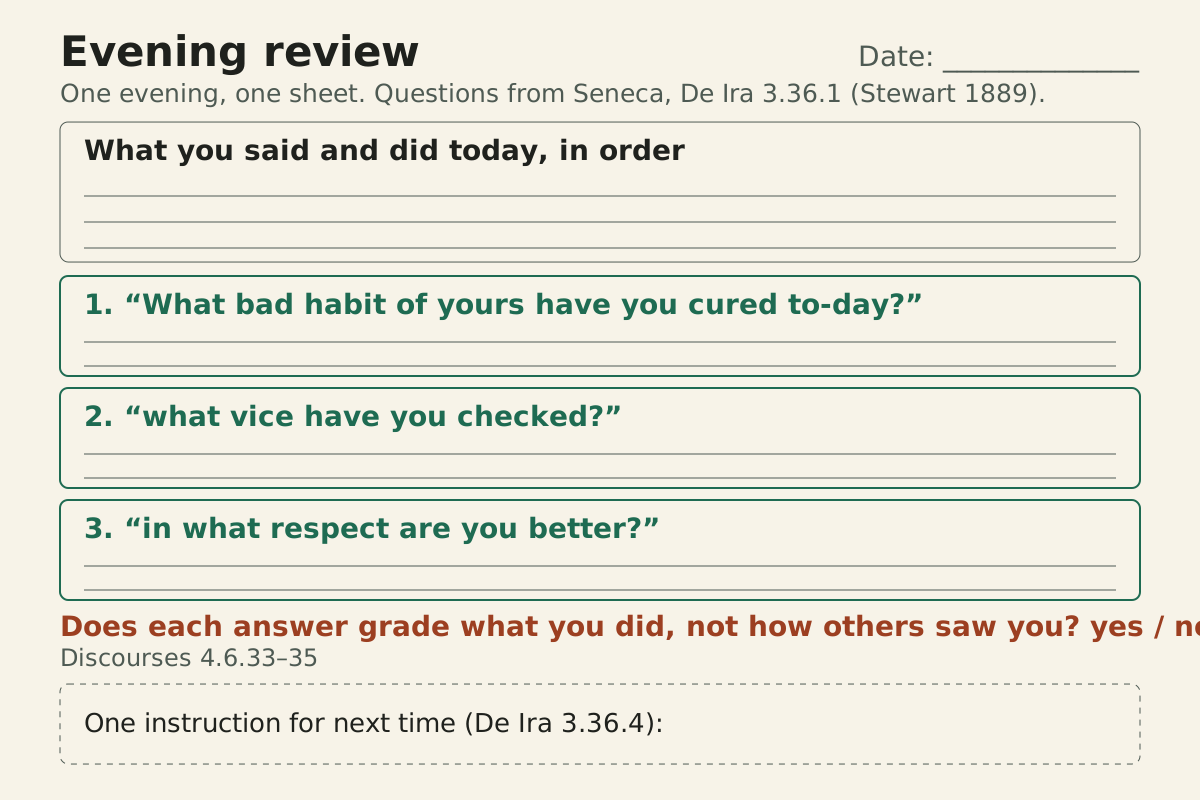
"What bad habit of yours have you cured to-day? what vice have you checked? in what respect are you better?"
Seneca, De Ira 3.36.1, Stewart translation (1889) — verified
"Quod hodie malum tuum sanasti? Cui vitio obstitisti? Qua parte melior es?"
Seneca, De Ira 3.36.1, Latin text ed. J. W. Basore (1928) — verified
Basore's 1928 Loeb translation drops "of yours" from the first question and renders the second "What fault have you resisted?" (De Ira 3.36.1, Basore translation — verified). In both English versions every question is about the person reviewing: a habit, a vice, an improvement.
Seneca then turns to himself. Once the lamp is out and his wife has fallen silent, he writes, "I pass the whole day in review before myself, and repeat all that I have said and done: I conceal nothing from myself, and omit nothing" (De Ira 3.36.3, Stewart translation — verified). His verdicts on himself are specific: he argued too hard in one dispute, and he corrected a man so freely that he offended him (3.36.4).
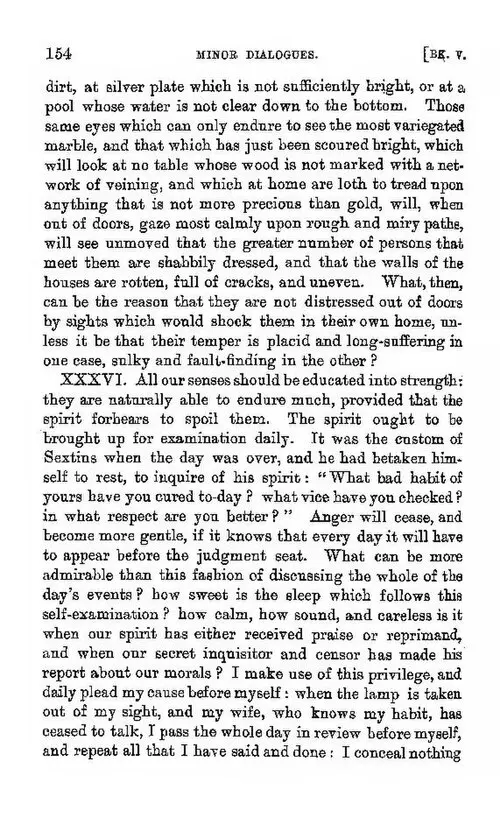
His reason belongs to a book on anger: "Anger will cease, and become more gentle, if it knows that every day it will have to appear before the judgment seat" (De Ira 3.36.2, Stewart translation — verified). That is Seneca's argument, not a tested result, and this page does not promise it.
Who was Sextius, and where does Pythagoras come in?
Seneca does not introduce Sextius in De Ira, and the sources describe him differently. Stewart's 1889 index files him as "Sextius, Q., a Stoic," while Basore's 1928 index calls Quintus Sextius an eclectic Roman philosopher of the late Republic and early Empire. In Letter 64, Seneca calls Quintus Sextius the Elder "a real Stoic, though he himself denies it" (Letters to Lucilius 64.2, Gummere translation — verified). Gummere's 1917 note says Sextius seems to have been "half-Stoic, half-Pythagorean," and the Internet Encyclopedia of Philosophy names "Fabianus the Sextian" among Seneca's teachers.
Epictetus credits someone else. In Discourses 3.10 he quotes verses for bedtime, and in 4.6.32 he calls their opening line "the saying of Pythagoras" (Discourses 4.6.32, Long translation — verified). George Long's 1877 note traces them to the Golden Verses attributed to Pythagoras, and the Stanford Encyclopedia of Philosophy entry on Epictetus (Margaret Graver, revised 2025-07-16) calls his bedtime self-examination "a practice borrowed from the Pythagorean tradition."
"Let sleep not come upon thy languid eyes / Before each daily action thou hast scann'd; / What's done amiss, what done, what left undone; / From first to last examine all, and then / Blame what is wrong, in what is right rejoice."
Epictetus, Discourses 3.10.2–3, Long translation (1877) — verified
He wants the verses kept "in such way that we may use them, not that we may utter them aloud" (Discourses 3.10.4, Long translation — verified). This site has a name for the distance between knowing the lines and using them on an ordinary evening: the armchair gap. None of the passages here says that Sextius took his questions from the Pythagoreans, so the chart below keeps the two credits apart.
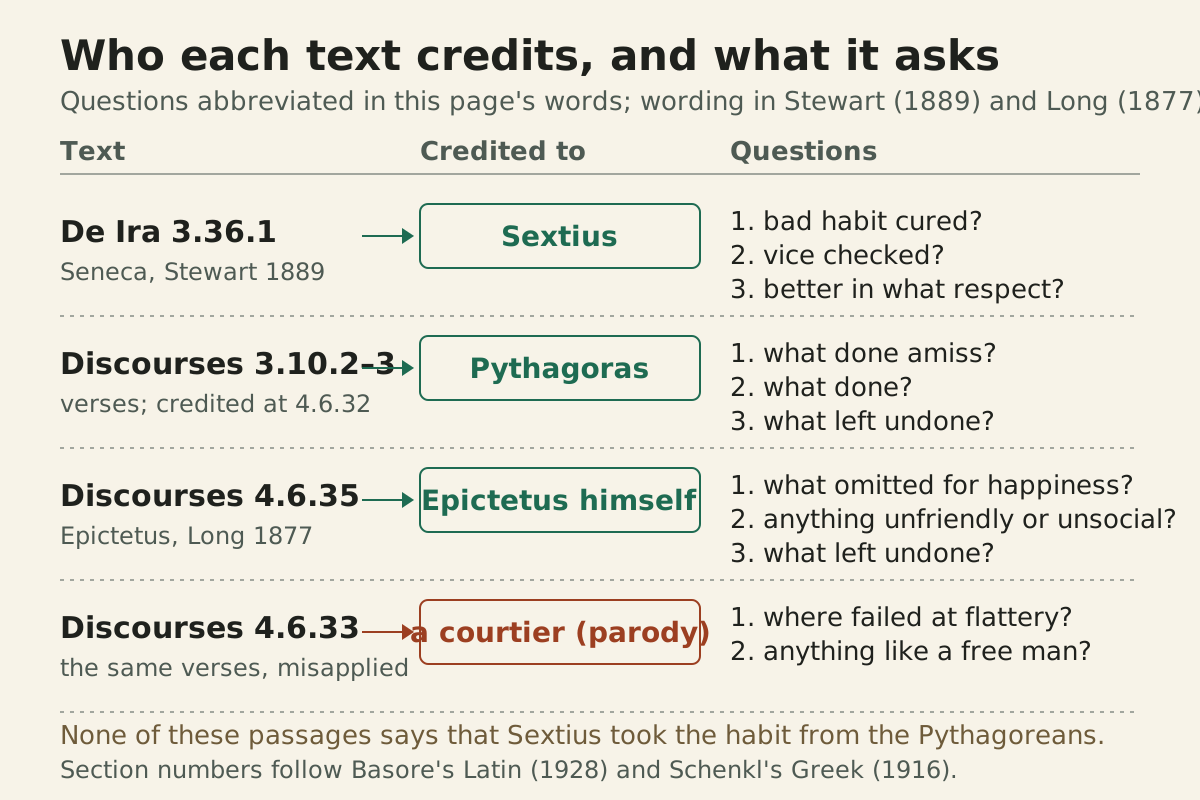
All four question sets, with coordinates, are in the question-set table (CSV, stoic-evening-routine-questions.csv).
How to do the evening review, step by step
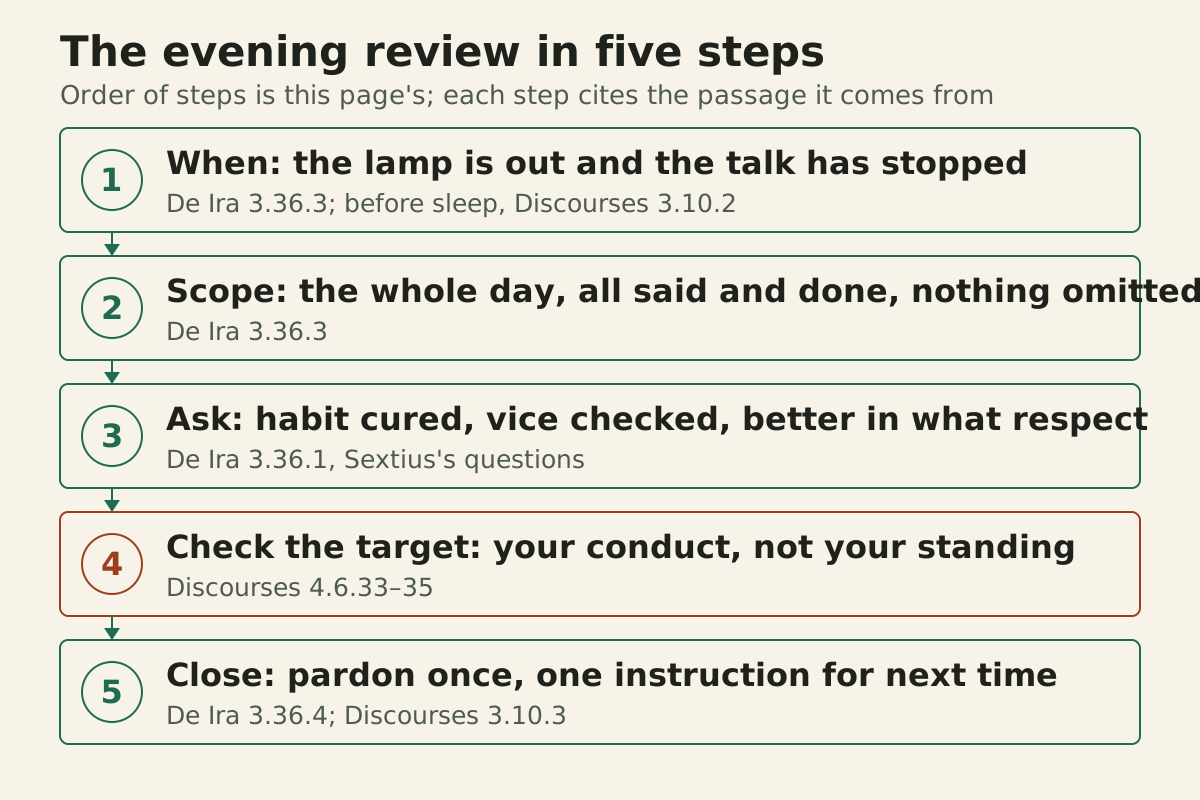
Each step below comes from one of these passages, and the order is this page's. Writing the answers down is this page's addition too. In Stewart's and Basore's translations, De Ira 3.36 describes a hearing Seneca holds with himself, and neither it nor Long's translation of the Epictetus passages used here mentions writing.
- Start when the day is done. Seneca begins once the lamp is taken out and his wife has stopped talking (De Ira 3.36.3); the verses put the review before sleep (Discourses 3.10.2).
- Go through the whole day. List what you said and did, leaving nothing out, as Seneca says he does (3.36.3).
- Ask Sextius's three questions. Find one bad habit cured, one vice checked and one respect in which you are better (3.36.1).
- Check what you are grading. In Discourses 4.6.31–33, Epictetus describes a courtier who spends his day seeking favor, then runs the Pythagorean questions on his flattery. Epictetus's own version asks where you left out "the things which conduce to happiness" and what you did that was unfriendly or unsocial (Discourses 4.6.35, Long translation — verified).
- Close the review. Seneca pardons himself once and gives himself instructions for next time (De Ira 3.36.4); the verses end on blaming what was wrong and taking pleasure in what was right (Discourses 3.10.3).
The sheet below fits one evening: a list of the day, a box for each question, the target check and one instruction.
What the texts do and don't say
Neither De Ira 3.36 nor the Epictetus passages quoted here set a length of time for the review: Stewart's and Basore's translations of Seneca and Long's of Epictetus name no minutes or hours. Seneca fixes when he starts and what he covers. He says the examination should happen daily (3.36.1). The drill on this page asks for one evening and sets no length either.
Seneca also makes claims about what follows. He describes the sleep after the review as calm and sound (3.36.2), and he expects anger to soften. The Stanford Encyclopedia of Philosophy entry on Seneca (Katja Vogt, revised 2024-02-13) notes that "his writings are not autobiographical" and that Seneca creates a literary persona, so the passage shows how Seneca presents himself, not a measured effect. Nothing on this page is offered as help for sleep, mood or anger.
The same entry cites the passage in a debate over whether Seneca discovers the self. A weaker reading, that he is concerned with shaping one's own life, is described there as widely accepted. Brad Inwood critiques a stronger one: that Seneca revises the Stoic account of the soul to make room for a self that reflects on itself.
_01.jpg)
Every question in these texts is about the reviewer's own conduct. For a verse from another tradition that also puts the weight on the act rather than its fruits, compare Bhagavad Gita 2.47. Your next step is one evening on paper, with the sheet above.
Practice
Off the page:
A drill for tonight, treated as one rep:
- Print the record sheet above, or copy its boxes onto a page.
- Before you sleep, list what you said and did today, one line each, in the order it happened.
- Answer each of Sextius's three questions with one item from the list; write "none" where nothing fits.
- Mark any answer that grades how others saw you rather than what you did, the courtier's slip in Discourses 4.6.33.
- Write one instruction for next time in Seneca's form, beginning "See that" or "In that dispute."
- If you also did today's drill on the dichotomy of control (the split between what is up to you and what is not), set the two sheets side by side; if you would rather end the evening on a puzzle, take the Zebra Puzzle.
Sources
- [1] Seneca, Minor Dialogues, together with the Dialogue on Clemency, trans. Aubrey Stewart (London: George Bell and Sons, 1889); Project Gutenberg eBook #64576 www.gutenberg.org/ebooks/64576 Consulted: Of Anger, Book III (Stewart's Book 5), chapter 36, pp. 154–155, and the index entry for Sextius
- [2] Seneca, Moral Essays, vol. 1, ed. and trans. John W. Basore, Loeb Classical Library (London: Heinemann, 1928) archive.org/details/moralessayswithe01seneuoft Consulted: On Anger 3.36, Latin text and English translation (pp. 338–341), and the index entry for Sextius
- [3] Epictetus, The Discourses of Epictetus; with the Encheiridion and Fragments, trans. George Long (London: George Bell and Sons, 1877); Wikisource en.wikisource.org/wiki/The_Discourses_of_Epictetus;_with_the_Encheiridion_and_Fragments Consulted: Book 3, chapter 10 (pp. 223–224) and Book 4, chapter 6 (pp. 339–344), with Long's notes
- [4] Epictetus, Dissertationes ab Arriano digestae, ed. Heinrich Schenkl, editio maior (Leipzig: Teubner, 1916); digital edition urn:cts:greekLit:tlg0557.tlg001.perseus-grc2, Perseus Digital Library, PerseusDL/canonical-greekLit (GitHub, commit 0189b9c) github.com/PerseusDL/canonical-greekLit/blob/0189b9c8d8d1f148133f2f0af309b4ee90ea4332/data/tlg0557/tlg001/tlg0557.tlg001.perseus-grc2.xml Consulted: Greek text of Book 3, chapter 10 and Book 4, chapter 6 Text licence: CC BY-SA 4.0
- [5] Seneca, Moral Letters to Lucilius, trans. Richard M. Gummere, Loeb Classical Library, vol. 1 (London: Heinemann, 1917); Wikisource en.wikisource.org/wiki/Moral_letters_to_Lucilius/Letter_64 Consulted: Letter 64, sections 1–5, with Gummere's note on Quintus Sextius
- [6] Margaret Graver, "Epictetus," Stanford Encyclopedia of Philosophy, first published 2008-12-23, substantive revision 2025-07-16 plato.stanford.edu/entries/epictetus/ Consulted: section 5, Educational method
- [7] Katja Vogt, "Seneca," Stanford Encyclopedia of Philosophy, first published 2007-10-17, substantive revision 2024-02-13 plato.stanford.edu/entries/seneca/ Consulted: section 1, Life and Works, and section 3.2, The Will and the Self
- [8] Robert Wagoner, "Seneca," Internet Encyclopedia of Philosophy, ISSN 2161-0002 iep.utm.edu/seneca/ Consulted: section 1, Life, Political Career, and Death
Cite this page
Virtue & Paradox. “Stoic Evening Routine: Seneca Credits the Habit to Sextius.” Published 2026-10-17; last substantive revision 2026-10-17. https://virtueandparadox.com/stoicism/stoic-evening-routine/. Accessed (the date you read it).